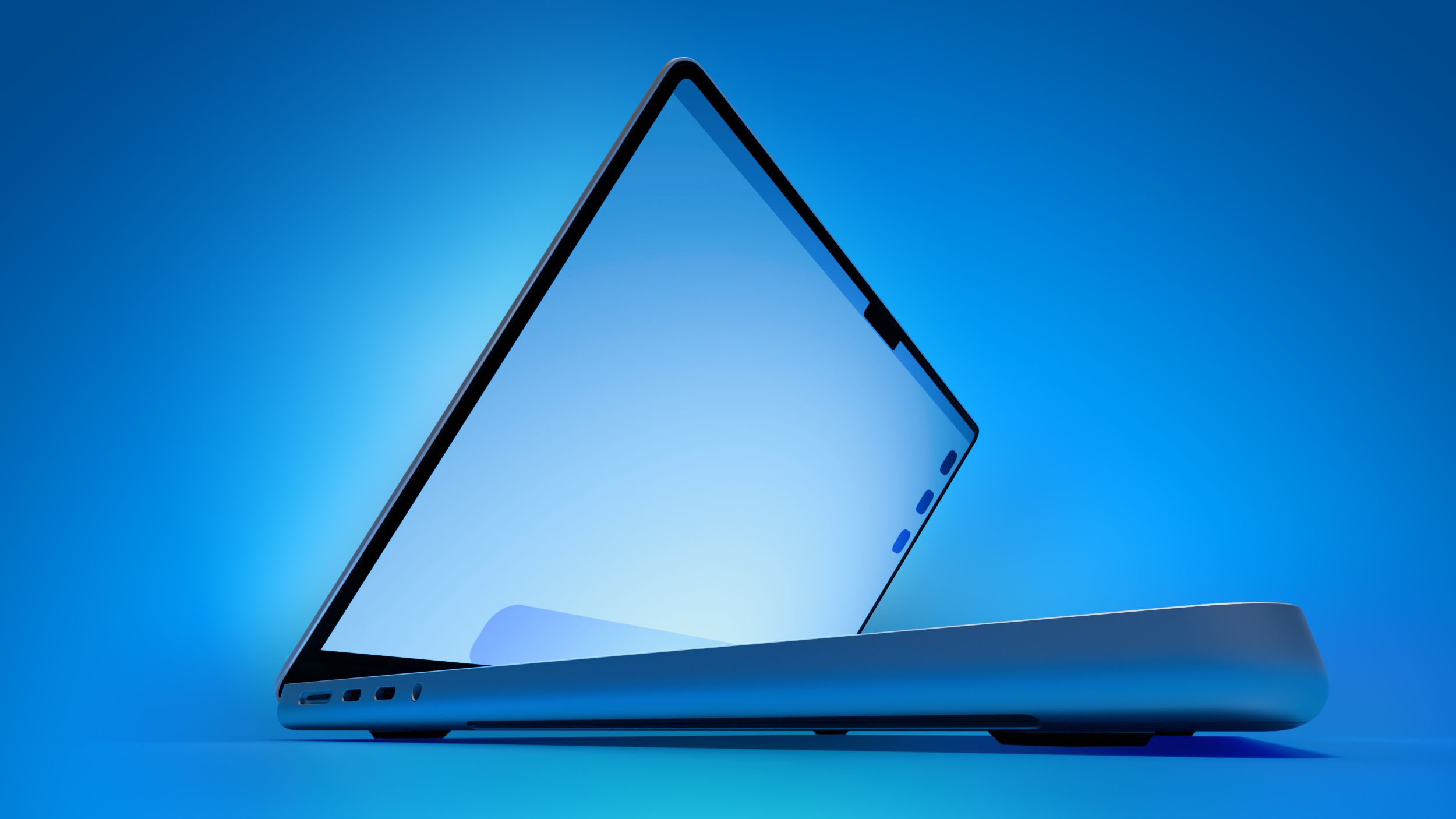
TL;DR
Apple is preparing a "MacBook Ultra" launch for late 2026, introducing a radically redesigned chassis with a 20-inch foldable display and a new M5 Ultra chipset. This move signals Apple's intent to merge the MacBook Pro and iPad Pro lines into a single premium device category, potentially disrupting the high-end laptop and tablet markets simultaneously.
What Happened
Apple is reportedly planning to launch a "MacBook Ultra" in late 2026, a device that will break from the traditional MacBook Pro form factor with a 20-inch foldable OLED display and an entirely new M5 Ultra processor. The leak, published by MacRumors on April 24, 2026, comes just weeks after Apple updated the 14-inch and 16-inch MacBook Pro with M5 Pro and M5 Max chips last month, suggesting a clear product tier separation is underway.
Key Facts
- The "MacBook Ultra" will feature a 20-inch foldable OLED display that folds into a 14-inch form factor when closed, marking Apple's first foldable computer.
- The device will be powered by the new M5 Ultra chip, a higher-end processor distinct from the M5 Pro and M5 Max chips introduced in March 2026.
- Apple is reportedly targeting a late 2026 launch date, with mass production expected to begin in Q3 2026.
- The MacBook Ultra will include six new features: a foldable OLED display, M5 Ultra chip, revised thermal architecture, enhanced battery life (targeting 20+ hours), a new Magic Keyboard with haptic feedback, and Wi-Fi 7 support.
- Pricing is expected to start at $3,499, positioning it above the current $2,499 16-inch MacBook Pro with M5 Max.
- The device will weigh approximately 3.5 pounds, significantly lighter than the 4.7-pound 16-inch MacBook Pro.
- Apple is using Samsung Display as the primary supplier for the 20-inch foldable OLED panel, with production capacity set at 1.5 million units in the first year.
Breaking It Down
The MacBook Ultra represents Apple's most aggressive hardware pivot since the transition from Intel to Apple Silicon in 2020. By introducing a 20-inch foldable display, Apple is directly challenging the notion that laptops and tablets must remain separate product categories. The device effectively combines a large-screen MacBook Pro with the portability of a compact 14-inch chassis, a form factor that no competitor—including Samsung with its Galaxy Book Fold or Lenovo with the ThinkPad X1 Fold—has successfully commercialized at scale.
$3,499 is the starting price for the MacBook Ultra, making it 40% more expensive than the top-tier 16-inch MacBook Pro with M5 Max at $2,499.
This price point is critical. Apple is deliberately positioning the MacBook Ultra as a luxury workstation rather than a mainstream laptop. At $3,499, it competes directly with high-end Windows workstations like the Dell Precision 7780 (starting at $3,199) and the HP ZBook Fury G11 (starting at $3,099). However, Apple's advantage lies in the M5 Ultra chip's unified memory architecture, which allows the device to handle 128GB of unified RAM—double the maximum of the M5 Max—making it a viable option for AI model training, 3D rendering, and video production workflows that currently require desktop-class hardware.
The six new features list reveals Apple's design priorities. The foldable OLED display is the headline, but the revised thermal architecture is arguably more consequential. Current MacBook Pro models throttle under sustained load, particularly the M5 Max chip in the 14-inch chassis. The MacBook Ultra's larger internal volume allows for a vapor chamber cooling system—a first for Apple laptops—that could sustain peak performance for hours without thermal throttling. Combined with the enhanced battery life target of 20+ hours, this suggests Apple is aiming for a device that can replace both a desktop workstation and a portable laptop for professionals who travel frequently.
The Wi-Fi 7 inclusion is also forward-looking. Wi-Fi 7 (802.11be) offers theoretical speeds of 46 Gbps—nearly 5x faster than Wi-Fi 6E—and lower latency critical for cloud-based AI workloads. Apple's decision to skip Wi-Fi 7 on the M5 Pro and M5 Max MacBook Pros, both released in March 2026, suggests the MacBook Ultra is designed for a different user: one who relies on high-bandwidth cloud computing, real-time collaboration, and large file transfers in professional environments.
What Comes Next
Apple's MacBook Ultra launch will unfold in several distinct phases, each carrying significant implications for the broader PC market:
-
WWDC 2026 (June): Apple is expected to preview the M5 Ultra chip architecture during the keynote, likely positioning it as the "most powerful chip ever in a Mac" with specific benchmarks against the M5 Max. Developers will need to prepare for a device with a 20-inch foldable display—which may run macOS in laptop mode and iPadOS in tablet mode, potentially requiring app optimization for both interfaces.
-
Q3 2026 Production Ramp: Samsung Display will begin mass production of the 20-inch foldable OLED panels in July 2026, with Apple targeting 1.5 million units in the first year. This is a modest volume compared to the 12 million MacBook Pros shipped in 2025, indicating Apple expects the MacBook Ultra to remain a niche, high-margin product.
-
Late 2026 Launch Event: The actual product reveal is expected at a September or October 2026 event, alongside the iPhone 18 and Apple Watch Series 11. Apple will likely frame the MacBook Ultra as the "future of computing," with live demonstrations of its foldable display and thermal performance.
-
Early 2027 Second-Generation Iteration: If the first-generation MacBook Ultra sells well, Apple is already planning a second-generation model with an M6 Ultra chip and a lower starting price of $2,999, according to supply chain sources. This would expand the addressable market beyond early adopters.
The Bigger Picture
The MacBook Ultra is Apple's clearest signal yet that it is betting on Convergent Devices—products that collapse multiple categories (laptop, tablet, monitor) into a single form factor. This trend, pioneered by Microsoft's Surface Pro and Samsung's Galaxy Z Fold series, has struggled to gain mainstream traction due to compromises in performance, battery life, and software. Apple's advantage is its vertical integration of hardware, silicon, and operating systems: the MacBook Ultra can run macOS when docked with a keyboard and iPadOS when used as a tablet, with seamless app switching enabled by the M5 Ultra chip's virtualization capabilities.
This strategy also reflects Apple's Post-PC Ambitions. With the MacBook Ultra, Apple is creating a device that can serve as a primary workstation for creative professionals, software developers, and AI researchers—the same audience that currently drives MacBook Pro and Mac Pro sales. By offering a foldable display, Apple is solving the "screen real estate vs. portability" trade-off that has plagued laptop design for decades. If successful, the MacBook Ultra could render the 16-inch MacBook Pro obsolete within three years, as professionals opt for a single device that offers both a large workspace and a compact travel form factor.
Key Takeaways
- [Price Premium]: At $3,499, the MacBook Ultra is Apple's most expensive laptop ever, targeting professionals who need desktop-class performance in a portable form factor.
- [Foldable Display]: The 20-inch foldable OLED display is Apple's first in a computer, using Samsung Display panels and collapsing to a 14-inch footprint.
- [M5 Ultra Chip]: The new processor supports up to 128GB unified RAM and vapor chamber cooling, positioning it for AI and creative workloads beyond the M5 Max's capabilities.
- [Market Timing]: Launching late 2026, the MacBook Ultra will compete with Windows foldables and high-end workstations, with a second-generation model already planned for early 2027.