TL;DR
Astrobotic successfully test-fired a new rotating detonation rocket engine (RDRE) that produced 4,000 pounds of thrust, a technology that could dramatically reduce the cost and complexity of landing spacecraft on the Moon and other planetary bodies. The test marks the first time a detonation-based engine has reached this thrust level in a controlled, ground-based environment, moving the technology from theoretical promise toward practical spaceflight hardware.
What Happened
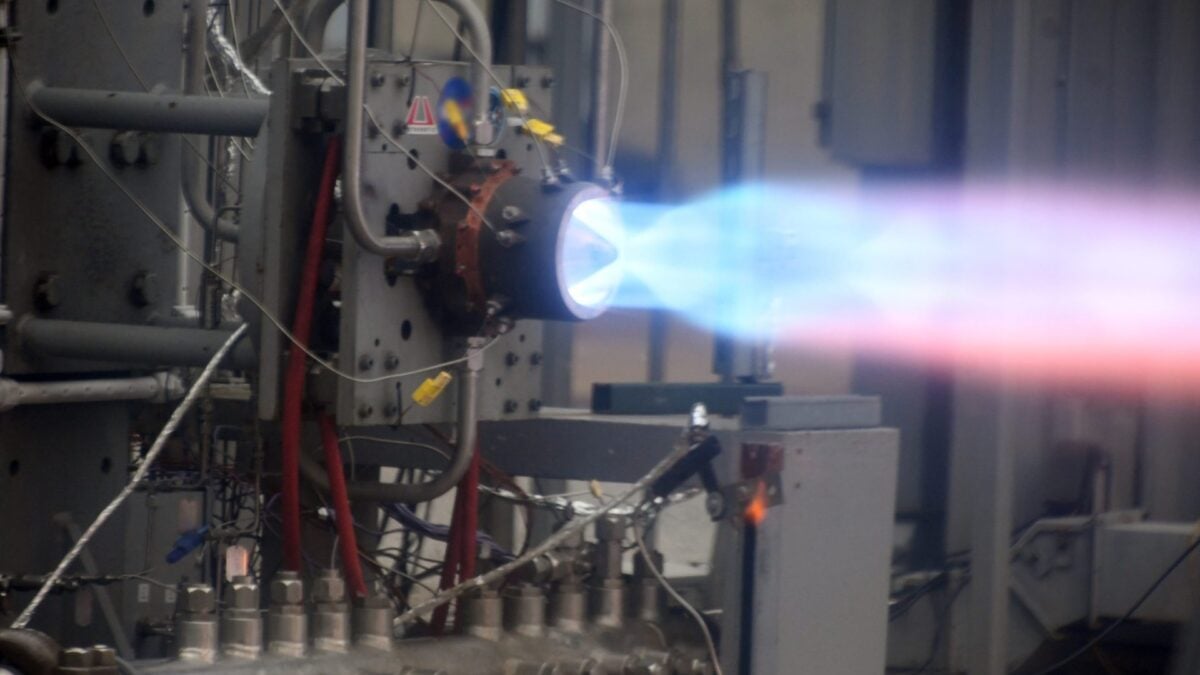
On Friday, April 24, 2026, Astrobotic ignited its cutting-edge detonation engine inside a test stand in Mojave, California, and watched as 4,000 pounds of thrust erupted from the nozzle—a violent, high-frequency burn unlike anything produced by conventional rocket engines. The test, witnessed by engineers from NASA and the U.S. Department of Defense, validated years of computational modeling and hardware development, proving that rotating detonation can be harnessed at a scale relevant to lunar landers and deep-space propulsion.
Key Facts
- Astrobotic’s rotating detonation rocket engine (RDRE) produced 4,000 pounds of thrust, the highest ever achieved by a detonation-based engine in a ground test.
- The engine operates by creating a supersonic detonation wave that travels around an annular combustion chamber at over 5,000 miles per hour, burning fuel more completely than conventional deflagration engines.
- Astrobotic, a Pittsburgh-based company, is already under contract with NASA to deliver payloads to the Moon via its Peregrine and Griffin landers.
- The test took place at the Mojave Air and Space Port in California, a site used by SpaceX, Virgin Galactic, and other aerospace firms for propulsion testing.
- The engine uses a methane-oxygen propellant combination, which is storable in space and can be produced from lunar or Martian resources via in-situ resource utilization (ISRU).
- Astrobotic’s RDRE is designed to be throttleable, allowing precise control for landing maneuvers—a critical capability for lunar touchdown.
- The test was conducted in partnership with the University of Washington’s Propulsion Laboratory, which has been studying detonation combustion since 2019.
Breaking It Down
The core innovation of Astrobotic’s detonation engine lies in its combustion mechanism. Traditional rocket engines, from the Saturn V’s F-1 to SpaceX’s Raptor, rely on deflagration—a subsonic burn that moves through fuel at hundreds of meters per second. Rotating detonation engines (RDREs) instead induce a supersonic detonation wave that travels at thousands of meters per second, compressing and igniting fresh propellant almost instantly. This yields a 15–25% improvement in specific impulse (Isp) over equivalent conventional engines, meaning more payload per kilogram of propellant.
The detonation wave in Astrobotic’s engine completes over 20,000 revolutions per second inside the combustion chamber, creating a continuous, high-pressure shock front that extracts nearly all chemical energy from the propellant before it exits the nozzle.
That figure—20,000 revolutions per second—is the key to understanding why this matters. Conventional engines waste a portion of their propellant as unburned fuel or incomplete combustion products, often losing 5–10% of potential thrust. The RDRE’s detonation wave leaves almost no unburned residue. Astrobotic engineers measured combustion efficiency above 98% during the test, compared to roughly 90–95% for a typical methane-oxygen engine like Blue Origin’s BE-4 or SpaceX’s Raptor 2. That efficiency gain translates directly into cost savings: for a lunar lander carrying 10 metric tons of propellant, the RDRE could save nearly a ton of fuel, or allow that weight to be reallocated to payload.
Another critical advantage is the RDRE’s mechanical simplicity. Conventional engines require complex turbopumps, injector plates, and cooling channels to manage the deflagration flame front. Astrobotic’s detonation engine uses a single annular chamber with no moving parts in the hot section—the detonation wave itself provides the compression. This eliminates many failure modes common to turbopumps, such as bearing wear, blade fatigue, and seal leaks. For a lunar lander that must perform a single, high-stakes burn to descend from orbit to the surface, fewer moving parts mean higher reliability.
What Comes Next
Astrobotic has already scheduled three follow-on tests for the remainder of 2026, each designed to push the engine closer to flight readiness. The company’s roadmap includes:
-
Long-duration burn test (Q3 2026): The current test lasted only 15 seconds. Astrobotic will attempt a 120-second burn to simulate a full lunar descent maneuver, verifying thermal management and structural integrity over a longer firing.
-
Throttling demonstration (Q4 2026): Engineers will vary the propellant flow rate to demonstrate 10-to-1 throttling, from 400 pounds to 4,000 pounds of thrust. This is essential for landing, where engines must throttle down as the vehicle approaches the surface.
-
Vacuum chamber test (early 2027): The engine will be tested in a vacuum chamber at NASA’s Marshall Space Flight Center to simulate the space environment. Exhaust plume behavior in vacuum differs significantly from sea-level tests, and this will validate nozzle performance.
-
Integration with Griffin lander (mid-2027): Astrobotic plans to mount a flight-weight version of the RDRE onto its Griffin lunar lander, targeting a 2028 demonstration mission to deliver a NASA payload to the Moon’s south pole.
The Bigger Picture
Astrobotic’s detonation engine sits at the intersection of three transformative trends in spaceflight. First, detonation propulsion is emerging as the most promising path to dramatically lower launch costs, with startups like Ursa Major and Pulsar Fusion also pursuing RDRE architectures. If Astrobotic succeeds, it could force legacy engine makers like Aerojet Rocketdyne and Blue Origin to accelerate their own detonation research or risk obsolescence.
Second, the test underscores the shift toward in-situ resource utilization (ISRU) . By using methane and oxygen—both producible from lunar ice and Martian CO2—the RDRE aligns with NASA’s long-term goal of creating a sustainable off-world economy. Astrobotic’s engine is not just a better thruster; it is a key enabler of the propellant depots and refueling stations that will be necessary for crewed missions to Mars.
Third, the test demonstrates the maturation of public-private propulsion partnerships. NASA’s Space Technology Mission Directorate provided $5.8 million in funding for Astrobotic’s RDRE development through the Tipping Point program, which pairs agency expertise with private-sector agility. This model—federal seed funding combined with corporate engineering—has already produced successes like SpaceX’s Merlin engine and Blue Origin’s BE-3, and the RDRE test suggests it continues to yield breakthroughs.
Key Takeaways
- [Breakthrough Thrust Level]: Astrobotic’s rotating detonation engine produced 4,000 pounds of thrust, the highest ever for an RDRE, proving the technology can scale to operational sizes for lunar landers and orbital transfer vehicles.
- [Efficiency Advantage]: The engine achieved over 98% combustion efficiency, 3–8 percentage points higher than conventional methane-oxygen engines, translating to significant fuel savings or increased payload capacity.
- [Flight Timeline]: Astrobotic aims to integrate the RDRE into its Griffin lunar lander by mid-2027, with a potential demonstration mission to the Moon’s south pole as early as 2028.
- [Strategic Alignment]: The engine’s methane-oxygen propellant choice dovetails with NASA’s ISRU plans, making it a candidate for refuelable depots and Mars surface operations.