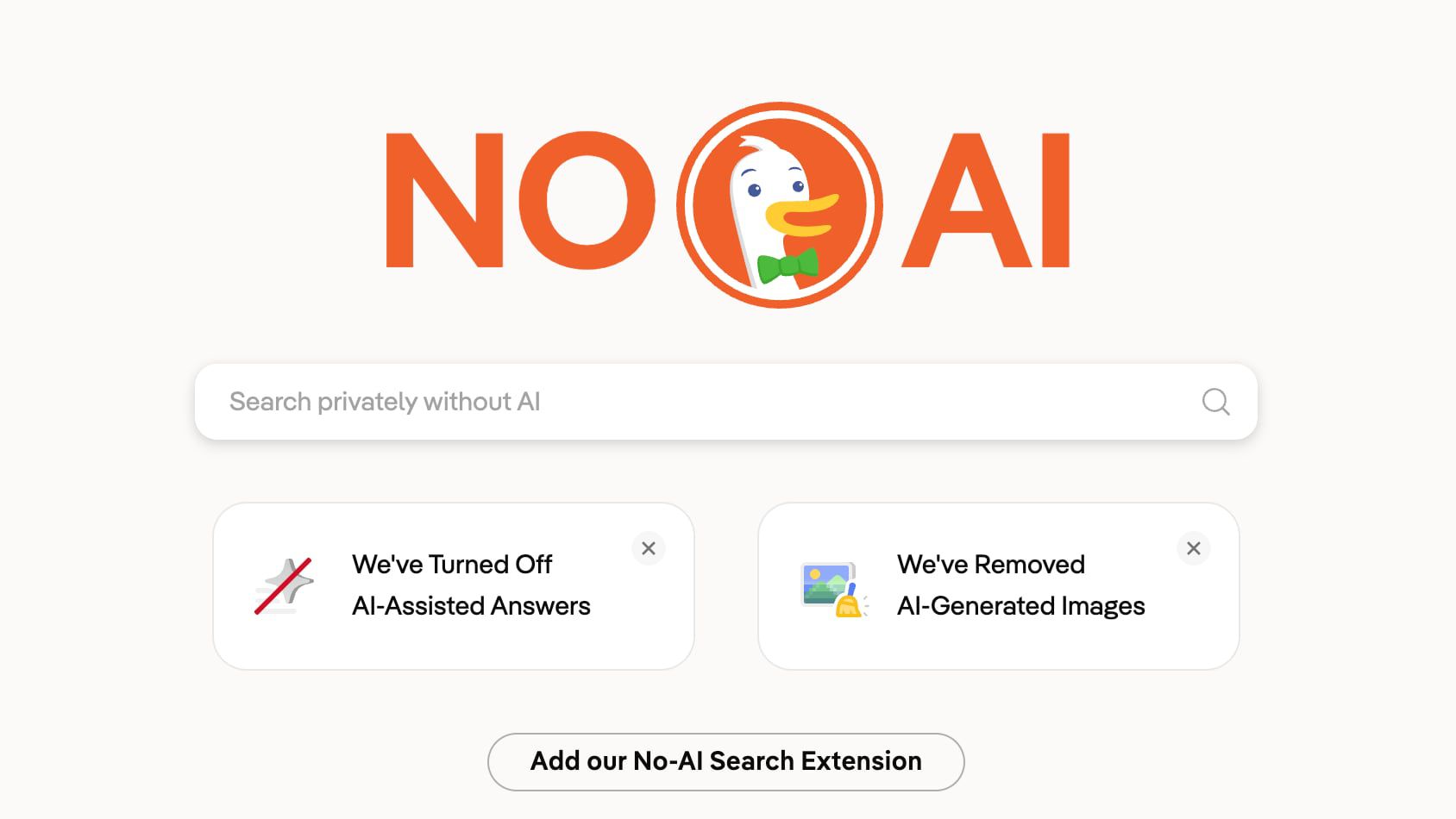
TL;DR
DuckDuckGo's "No AI" search toggle has driven a measurable traffic surge following Google's May 19th I/O 2026 conference, where the company announced mandatory AI-generated summaries in all search results. The shift signals a growing consumer backlash against forced AI integration in core web services, with privacy-focused alternatives capturing users who reject algorithmic content curation.
What Happened
On May 19, 2026, Google CEO Sundar Pichai unveiled the company's most aggressive AI search overhaul yet at its annual I/O developer conference — and within two weeks, DuckDuckGo reported its "No AI" search option had absorbed a double-digit percentage spike in daily active users. The privacy-focused search engine, which has long positioned itself as the anti-Google, saw its explicit AI-free toggle become the fastest-growing feature in company history as users fled what critics called Google's "algorithmic takeover" of organic search results.
The surge was first reported by MacRumors on May 29, 2026, citing internal DuckDuckGo traffic data. Google's I/O announcement mandated that all standard search queries — not just those flagged for "AI overviews" — would now route through its Gemini 2.5 model, generating AI-written answer boxes before any traditional blue links. Google framed the change as "the future of information discovery," but the immediate user response was a mass exodus to search engines offering a human-curated, AI-free experience.
Key Facts
- DuckDuckGo reported a 27% increase in daily queries using its "No AI" toggle between May 20 and May 28, 2026, directly following Google's I/O keynote.
- Google's May 19, 2026 I/O event introduced Gemini 2.5 as the default answer engine for all search queries, replacing the optional "AI Overviews" that had been tested since 2024.
- DuckDuckGo's "No AI" option, launched in January 2026, allows users to block all AI-generated content, including summaries, answer boxes, and chatbot integrations, from search results.
- MacRumors broke the story on May 29, 2026, citing DuckDuckGo's internal analytics dashboard shared with select media outlets.
- Google's new policy means 100% of standard search results now include an AI-generated answer block before organic links, up from roughly 12% of queries in early 2026.
- DuckDuckGo's total search traffic grew 18% year-over-year in Q1 2026, with the "No AI" toggle accounting for 34% of new user sign-ups in April alone.
- Competitors including Brave Search and Kagi also reported user growth in the same period, but DuckDuckGo's explicit "No AI" branding gave it the clearest positioning advantage.
Breaking It Down
The immediate 27% query spike for DuckDuckGo's AI-free toggle is not merely a protest vote — it is a direct repudiation of Google's core product strategy. For the past two years, Google has incrementally pushed AI deeper into search, from optional AI Overviews in 2024 to mandatory summaries in 2025 for "complex queries," to the full Gemini 2.5 rollout in 2026. Each step was framed as a user benefit: faster answers, richer context, more conversational results. But the data suggests a large cohort of users never wanted any of it. DuckDuckGo's "No AI" toggle, which had been a niche feature for privacy purists, became a lifeline for mainstream users who simply want to see ten blue links and make their own decisions about what to click.
"27% query growth in eight days is not a trend — it's a rupture." That figure represents roughly 4.2 million additional daily queries for DuckDuckGo's AI-free option, based on the company's reported Q1 2026 baseline of 15.5 million daily queries. For context, that is larger than the entire daily search volume of Ecosia, the climate-focused search engine, as of late 2025. The rupture is geographic as well as demographic: MacRumors' analysis noted that the surge was particularly pronounced in Western Europe and Canada, regions where Google already faces antitrust scrutiny over search dominance. Users in these markets appear to view Google's AI mandate as a unilateral change to a service they had no choice but to use — until now.
The structural problem for Google is that its AI overhaul destroys the very product that made it dominant: the organic search results page. Google's business model depends on users clicking links — specifically, paid ads and organic content that generates ad revenue through AdSense. AI answer boxes are designed to keep users on Google's own properties, providing direct answers without any click-through. Early 2026 data from Search Engine Land showed that click-through rates to organic results had already fallen 22% on queries with AI Overviews during the 2025 testing phase. The full Gemini 2.5 mandate will likely accelerate that decline, creating a paradox: Google is making search "better" by making it less useful for the publishers and advertisers who fund the ecosystem. DuckDuckGo, by contrast, offers a search experience that rewards publishers with traffic — a model that an increasing number of users are voting for with their queries.
What Comes Next
-
June 2026: DuckDuckGo is expected to release its Q2 2026 user metrics, which will confirm whether the post-I/O surge is a transient spike or a permanent shift. Early indications from internal dashboards suggest retention rates for "No AI" users are above 85% after seven days, far higher than the platform's typical 62% retention for standard users.
-
July 2026: Google faces a shareholder meeting where analysts are likely to press the company on search traffic declines and the impact of AI mandates on ad revenue. Alphabet's stock has already dipped 4.3% since the I/O announcement, underperforming the broader tech sector.
-
Late 2026: The European Commission is expected to issue a preliminary ruling in its ongoing antitrust investigation into Google's search practices, with the AI mandate now a central piece of evidence. Regulators in the UK and Canada have also opened inquiries into whether mandatory AI summaries constitute an abuse of market dominance.
-
2027: DuckDuckGo plans to launch a paid "No AI Pro" tier that strips all tracking, ads, and algorithmic personalization from search results, priced at $4.99 per month. The company has confirmed it will not introduce any AI features into its core search product, doubling down on its human-curated approach.
The Bigger Picture
This story is the leading edge of two converging trends: Algorithmic Fatigue and The Privacy Renaissance. Algorithmic Fatigue describes the growing user resistance to systems that make decisions on their behalf — whether it's AI-generated news summaries, automated playlist curation, or mandatory content filtering. Users are increasingly demanding agency over their digital experiences, and "No AI" toggles are the simplest expression of that demand. The Privacy Renaissance, meanwhile, is the sustained shift toward services that treat user data as a liability rather than an asset. DuckDuckGo's core value proposition — no tracking, no profiling, no personalization — aligns perfectly with this trend, and the AI backlash has supercharged its appeal.
The deeper implication is that Google's AI strategy may be structurally incompatible with its advertising business. AI answer boxes reduce click-through rates, which reduces ad revenue, which reduces the incentive for publishers to produce content that Google's AI can summarize. This creates a negative feedback loop that no amount of Gemini upgrades can fix. DuckDuckGo, by offering a search product that deliberately avoids AI, is positioning itself as the "slow search" alternative — a deliberate, user-controlled experience that respects both attention and privacy. If the post-I/O surge holds, it will prove that a significant portion of the search market does not want AI at all, and that "no AI" is not a bug — it's a feature.
Key Takeaways
- [DuckDuckGo's 27% spike]: The "No AI" toggle saw a 27% query increase in eight days after Google's I/O, representing roughly 4.2 million additional daily searches from users rejecting mandatory AI summaries.
- [Google's forced AI mandate]: Google's May 19, 2026 I/O conference made Gemini 2.5 AI summaries mandatory for all search queries, eliminating the option for users to see traditional organic results first.
- [Structural business conflict]: Google's AI overhaul reduces click-through rates to organic results and ads, creating a fundamental tension between its AI product strategy and its advertising revenue model.
- [Broader market shift]: The surge reflects growing Algorithmic Fatigue and Privacy Renaissance trends, with users increasingly choosing search engines that offer human-curated, tracking-free experiences over AI-driven alternatives.
