TL;DR
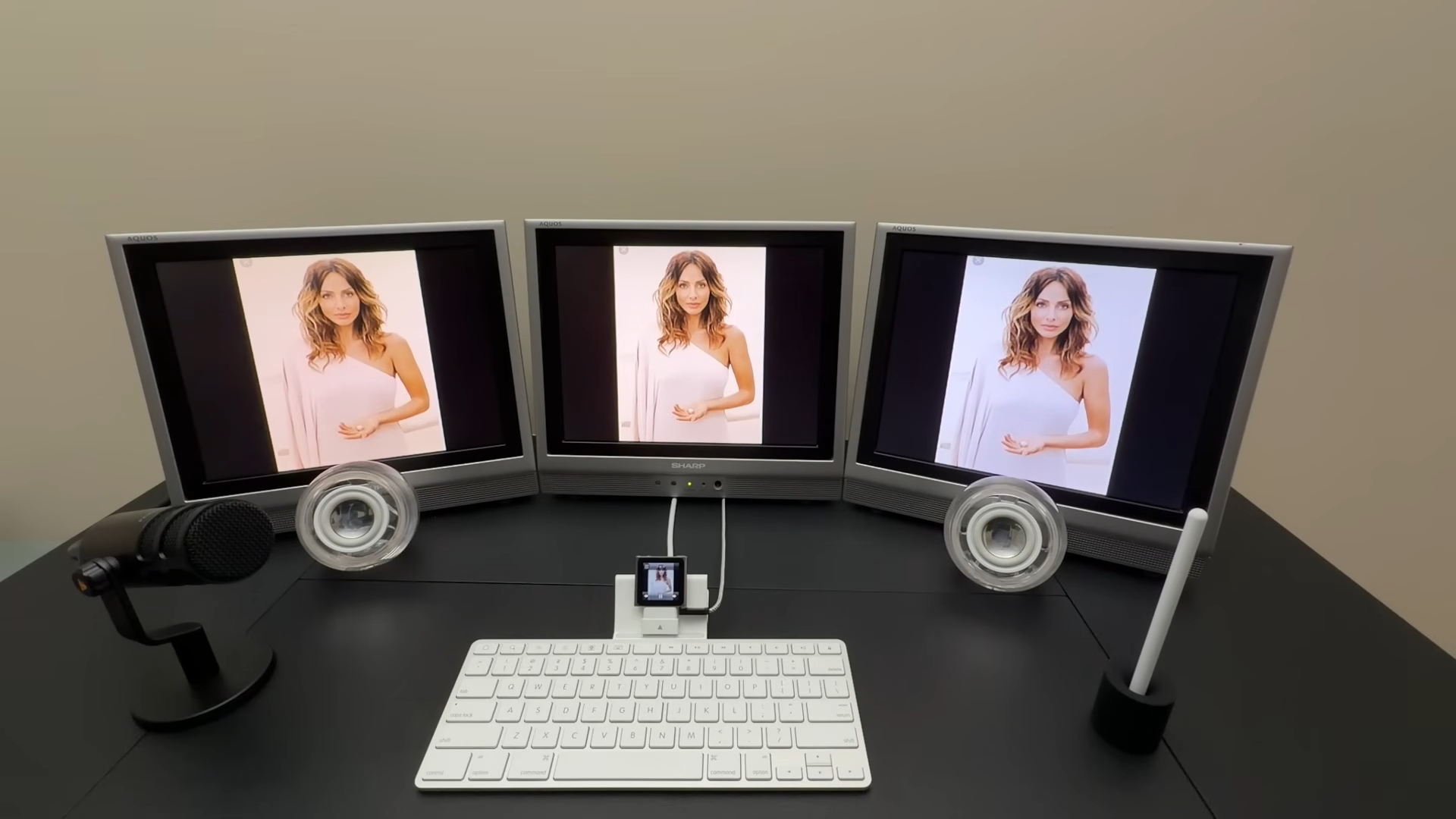
A hardware hacker known as [Will It Work?] has modified a classic iPod Nano to drive three external monitors, creating a deliberately absurd triple-monitor workstation from a device never intended to output any video. The project underscores how far display connectivity and miniaturisation have advanced, and serves as a technical commentary on the productivity-obsessed culture of multi-monitor computing.
What Happened
The iPod Nano, a 2005-era music player with a 1.5-inch screen and no native video output, has been hacked to run three external monitors in a project that turns the concept of a "portable workstation" on its head. Published on May 3, 2026, by the hardware blog Hackaday, the build by creator [Will It Work?] repurposes the Nano's internal 30-pin connector and leverages modern display driver chips to push video to three separate screens simultaneously.
Key Facts
- The project was published on Hackaday on May 3, 2026, by a creator identified as [Will It Work?].
- The base device is a first-generation iPod Nano, released in 2005 with a 1.5-inch colour display and 4 GB of storage.
- The iPod Nano originally had no video output capability — its 30-pin connector carried only audio, data, and charging signals.
- The hack uses three external display driver boards connected to the Nano's internal logic board via custom firmware and hardware modifications.
- Each monitor is driven through a separate video output channel, likely repurposing unused pins on the 30-pin connector or tapping directly into the Nano's display controller.
- The creator describes the build as a "sillier take" on the common trend of triple-monitor workstations used for productivity.
- The project required soldering, firmware reverse-engineering, and custom cable fabrication to achieve the multi-monitor output.
Breaking It Down
The iPod Nano triple-monitor hack is, on its surface, absurd — a device with a 1.5-inch, 176×132 pixel screen now driving three full-size monitors. But the technical achievement reveals how far embedded display technology has come. The Nano's original display controller was a simple, low-resolution part designed for a single tiny LCD. To extract three separate video streams, [Will It Work?] had to bypass the stock controller entirely, likely tapping into the device's parallel or serial display bus and feeding it into modern HDMI or DisplayPort encoder chips.
The iPod Nano's original display controller could handle only 23,232 pixels total — roughly 0.02% of a single 1080p monitor's 2.07 million pixels. The three external monitors together represent a pixel count over 250,000 times greater than the Nano's native screen.
This pixel count disparity is the core of the project's humour and technical difficulty. Modern display driver ICs from companies like Texas Instruments and Analog Devices can accept low-resolution input and scale it to higher resolutions, but doing so for three independent outputs requires careful clock management and signal routing. The creator likely used a field-programmable gate array (FPGA) or microcontroller to intercept the Nano's display data, split it into three streams, and feed each into a separate HDMI transmitter. The result is a system where the iPod Nano acts as a glorified video source, while the real work is done by modern silicon.
The project also highlights the untapped potential in legacy device connectors. Apple's 30-pin connector, used from 2003 to 2012, carried far more signals than Apple officially documented. Third-party developers and hackers have long exploited unused pins for serial communication, analog audio, and — as in this case — video output. This hack pushes that approach to its logical extreme, using every available signal path to achieve a function Apple never intended.
What Comes Next
The immediate future of this project is likely documentation and refinement. [Will It Work?] has not released schematics or firmware source code as of the article's publication, but such projects on Hackaday often lead to open-source releases. If the creator publishes detailed build instructions, a small community of hardware hackers may attempt to replicate or improve the design.
- Open-source release: The creator may post firmware code, PCB design files, and wiring diagrams on GitHub or a personal blog within the next 30–60 days, enabling others to build their own versions.
- Performance benchmarks: Expect follow-up testing from the hardware hacking community — measuring frame rates, resolution limits, and power draw when driving three monitors from the Nano's ARM-based processor.
- Commercial interest: Niche companies like Adafruit or SparkFun could create breakout boards or kits that simplify the modification, though the market is extremely small.
- Derivative hacks: Other retro devices — iPod Classic, Zune, or early smartphones — may see similar multi-monitor hacks as the technique becomes better understood.
The Bigger Picture
This project sits at the intersection of two broader trends: retro hardware hacking and the productivity display arms race. The retro hacking community has grown significantly since 2020, driven by YouTube channels like Strange Parts, This Does Not Compute, and DIY Perks that turn obsolete gadgets into functional modern devices. The iPod Nano triple-monitor build is a direct descendant of the "iPod Linux" and "iPod display mods" that began in the mid-2000s, but updated with modern display driver chips that make such outputs practical.
The second trend is the proliferation of multi-monitor setups in knowledge work. Triple-monitor workstations, once the domain of stock traders and video editors, have become common among programmers, designers, and remote workers. [Will It Work?] explicitly calls his project a "sillier take" on this phenomenon, implicitly critiquing the assumption that more screens always means more productivity. By attaching three monitors to a device with 4 GB of storage and a 400 MHz processor, he exposes the absurdity of chasing pixel count without considering the underlying computational power.
Key Takeaways
- [The Hack]: A first-generation iPod Nano has been modified to drive three external monitors, a 250,000x increase in pixel output over its native display.
- [The Method]: The build uses modern display driver ICs and custom firmware to tap into the Nano's internal display bus, bypassing the original controller.
- [The Critique]: The project satirizes the productivity-obsessed trend of triple-monitor workstations by pairing them with an underpowered 2005 music player.
- [The Significance]: The hack demonstrates the untapped capability in legacy device connectors and the power of modern display chips to scale low-resolution sources.