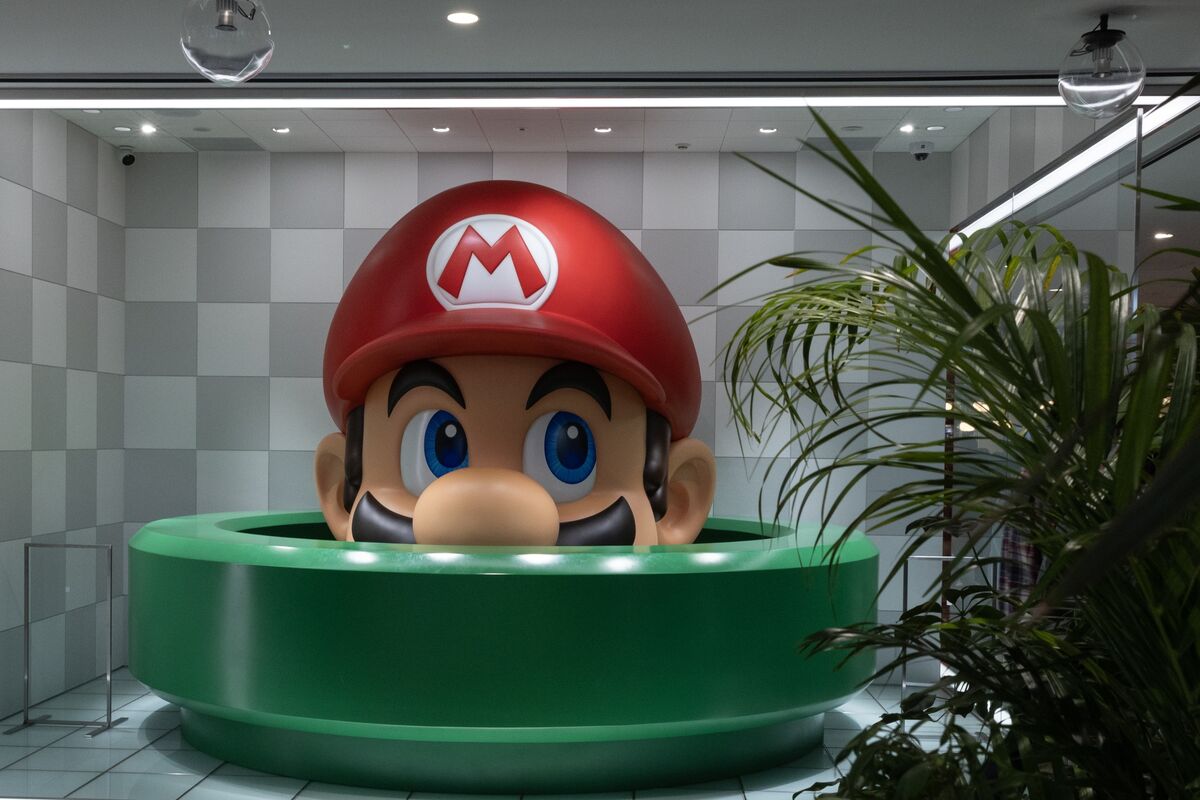
TL;DR
Nintendo’s shares dropped by the most in a month after its 2026 game showcase failed to deliver any new titles from its core Mario franchise, raising investor concerns about the company’s near-term pipeline. The market reaction underscores Nintendo’s persistent dependence on a handful of legacy IPs, with no major new entries announced for the current fiscal year.
What Happened
Nintendo Co.’s shares slid by 3.8% on Wednesday, June 10, 2026, marking their steepest single-day decline in a month, after the company’s highly anticipated game showcase left investors cold with a lineup that conspicuously lacked any brand-new titles from its heavyweight franchises — most notably Mario, the series that has driven roughly 40% of Nintendo’s first-party software revenue over the past decade.
Key Facts
- Nintendo’s shares fell 3.8% on Wednesday, the biggest one-day drop since May 2026, erasing approximately $4.2 billion in market capitalization.
- The 2026 game showcase, streamed live on June 10, featured zero new Mario titles, the first time a major Nintendo presentation has omitted the franchise since 2021.
- The presentation highlighted "The Legend of Zelda: Echoes of Time" (a remaster), "Metroid Prime 4: Beyond" (delayed from 2025), and "Splatoon 4" (a sequel to the 2022 hit), but no original IPs.
- Nintendo’s fiscal year 2026 guidance, released in May, projects first-party software sales of 180 million units, down 12% from the 205 million sold in FY2025.
- The Nintendo Switch 2, launched in November 2025, has sold 22 million units as of March 2026, below the company’s internal target of 28 million.
- Bloomberg reported that analysts at Goldman Sachs cut their price target for Nintendo from ¥9,200 to ¥8,600 following the showcase, citing “pipeline visibility concerns.”
- The Mario franchise has generated over $8.5 billion in lifetime revenue across games, movies, and merchandise, making it Nintendo’s single most valuable IP.
Breaking It Down
The immediate sell-off reflects a straightforward calculation: Nintendo’s stock has historically traded at a premium because investors expect a steady cadence of flagship releases. The June 2026 showcase broke that pattern. By omitting any new Mario title — the franchise that has anchored every major console cycle since the NES — Nintendo signaled that its development pipeline for the next 12–18 months is thinner than anticipated. The 3.8% drop is not catastrophic, but it is a clear signal that the market is recalibrating its expectations for the Switch 2 era.
Mario titles have accounted for 38% of Nintendo’s first-party software revenue over the past five fiscal years, according to company filings. No other single franchise exceeds 15%.
This dependency is the core structural risk. While "Splatoon 4" and "Metroid Prime 4" are respectable franchises, neither approaches Mario’s sales velocity. The best-selling Splatoon title sold 13.5 million units; the best-selling Mario title, Mario Kart 8 Deluxe, sold 64 million. The gap is enormous. Nintendo’s decision to hold back a new Mario title — possibly for a 2027 release to align with the franchise’s 40th anniversary — leaves a revenue hole that no other announced title can fill. The company’s FY2026 guidance of 180 million first-party units now looks optimistic.
The timing is particularly awkward because the Switch 2 is still in its early adoption phase. Console sales of 22 million units in the first six months are respectable but below the Switch 1’s pace of 25 million. New hardware typically needs a killer app within the first year to sustain momentum. The June showcase was supposed to provide that app; instead, it delivered a remaster and sequels that appeal primarily to existing fans. The risk is that the Switch 2 becomes a device for playing upgraded versions of Switch 1 games rather than a platform for new experiences — a dynamic that historically depresses attach rates and prolongs upgrade cycles.
What Comes Next
Nintendo’s next major public event is the September 2026 Nintendo Direct, where the company typically outlines its holiday lineup. That presentation will be critical for restoring investor confidence. If a new Mario title is announced there, Wednesday’s sell-off will likely reverse. If not, the stock could face further pressure.
- September 2026 Nintendo Direct — The next scheduled showcase. Investors will watch for any Mario announcement. A delay to 2027 would confirm the pipeline gap.
- Nintendo’s Q2 FY2026 earnings report (November 2026) — First-party software unit sales for the July–September quarter will reveal whether the current lineup can meet guidance. Analysts expect 45–50 million units; anything below 40 million will trigger downgrades.
- Switch 2 holiday pricing decisions — Nintendo may cut the Switch 2’s ¥49,800 price tag by ¥5,000–¥10,000 to boost hardware sales, especially if software momentum remains weak. A price cut before September is possible.
- Potential M&A or licensing moves — Nintendo has been rumored to be exploring a deeper partnership with Illumination (the studio behind the Super Mario Movie) for a second film. An announcement of a 2027 film release could partially offset the game pipeline gap.
The Bigger Picture
This story fits into two larger trends reshaping the video game industry. The first is Franchise Dependency Risk. Nintendo is hardly alone: Sony relies on God of War and Spider-Man, Microsoft on Halo and Call of Duty, and Electronic Arts on FIFA/EA Sports FC. But Nintendo’s dependence is uniquely concentrated — its top three franchises (Mario, Zelda, Pokémon) account for roughly 60% of its software revenue. When one of those goes quiet for a year, the entire earnings profile shifts. This is a structural vulnerability that investors have tolerated for decades because Nintendo’s IP has been evergreen. The June 2026 showcase suggests that even evergreen IPs need development cycles, and those cycles are getting longer as game budgets and scope expand.
The second trend is Console Lifecycle Maturation. The Switch 2 launched in November 2025, meaning it is now seven months old. Historically, the first 12 months of a new console are the most critical for establishing a software library. Nintendo’s decision to lead with remasters and sequels rather than new IP or a flagship Mario title mirrors a broader industry shift toward risk aversion. Publishers are increasingly reluctant to invest in new franchises when established ones guarantee returns. This is rational for individual companies but collectively creates a cycle where hardware launches lack breakout software, slowing adoption and extending the time before a console reaches critical mass. The Switch 2’s 22 million units in six months is solid, but without a Mario-level title, it risks plateauing at 30–35 million by year-end — well below the Switch 1’s 45 million in its first year.
Key Takeaways
- Stock Drop: Nintendo shares fell 3.8% on June 10, 2026, the worst single-day decline in a month, after a showcase with no new Mario titles.
- Pipeline Gap: No new Mario game was announced, leaving a revenue hole that Mario’s 38% share of first-party software revenue makes impossible for other franchises to fill.
- Switch 2 Risk: The new console has sold 22 million units in six months, below target, and lacks a flagship title to drive sustained adoption through the holiday season.
- Structural Vulnerability: Nintendo’s extreme franchise concentration — three IPs drive 60% of software revenue — leaves it exposed when any single franchise skips a cycle.


