TL;DR
A pair of corroded metal objects from an Iberian Bronze Age treasure hoard have been identified as containing meteoric iron — material forged from a space rock that fell to Earth over 3,000 years ago. This discovery, published in a new analysis, confirms that ancient Iberian smiths possessed the technical skill to work celestial metal long before the Iron Age, rewriting the timeline of metallurgical sophistication in prehistoric Europe.
What Happened
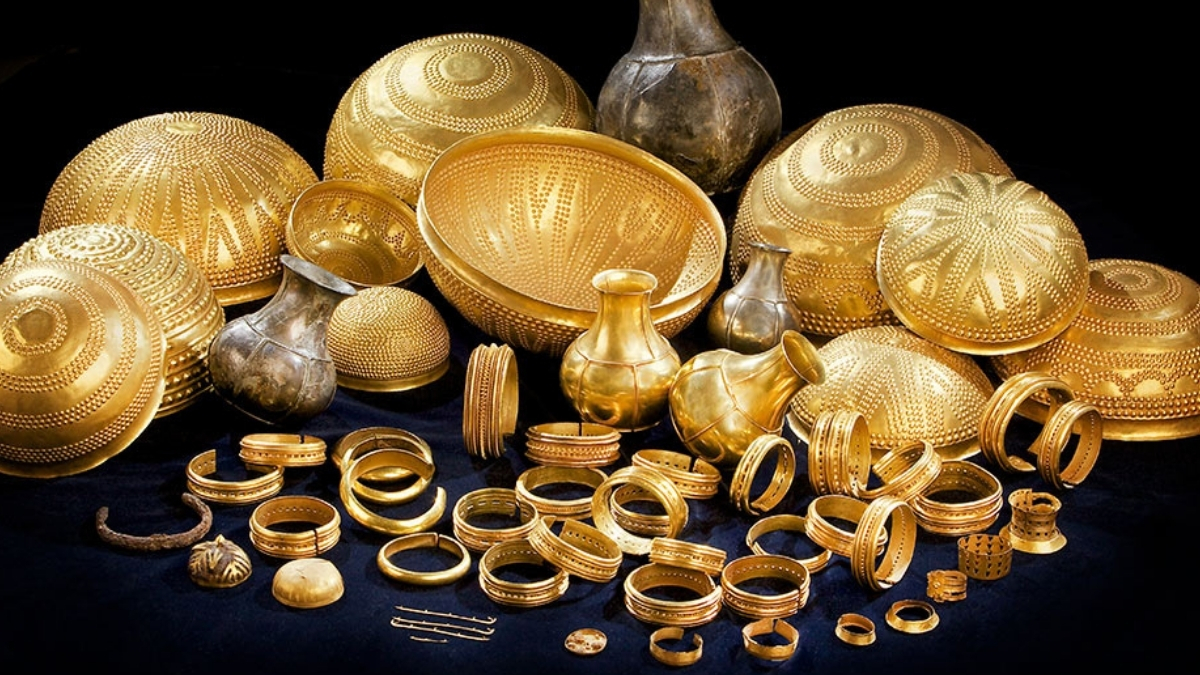
Deep inside a glittering cache of golden treasures from the Iberian Bronze Age, two unassuming, corroded objects have been identified as the most precious artifacts of all: they are made from meteoric iron, a material that fell to Earth from beyond our world. The discovery, published by researchers analyzing artifacts from the Villena Treasure — a hoard unearthed in 1963 near Alicante, Spain — reveals that ancient smiths worked with celestial metal over 3,000 years ago, pushing back the known date of ironworking in the region by centuries.
Key Facts
- The Villena Treasure, discovered in 1963 near Alicante, Spain, contains 66 gold objects and a handful of iron-based artifacts from the Iberian Bronze Age (roughly 1500–1200 BCE).
- The two analyzed objects — a bracelet and a small hollow sphere — were found to have a nickel content of 5–8% , consistent with meteoric iron rather than terrestrial smelted iron.
- Researchers from the Spanish National Research Council (CSIC) and the University of Vigo conducted the metallurgical analysis, published in the journal Trabajos de Prehistoria in 2025.
- The artifacts date to approximately 1400–1200 BCE , meaning they were crafted before the Iron Age (which began in Iberia around 800 BCE).
- Meteoric iron was prized in ancient cultures because it could be cold-forged without smelting, yet it was harder than copper or bronze — a technological advantage for tools and ornaments.
- The Villena Treasure is housed at the Museo Arqueológico de Alicante (MARQ), where the objects have been re-cataloged following this analysis.
- This finding aligns with other known meteoric iron artifacts, such as Tutankhamun's dagger (14th century BCE, Egypt) and the Gibeon meteorite tools from Namibia (1st millennium BCE).
Breaking It Down
The identification of meteoric iron in the Villena Treasure resolves a long-standing archaeological puzzle. Since the hoard's discovery in 1963, the iron objects were considered anomalous — Iron Age technology appearing in a Bronze Age context. But the high nickel content now confirms that the iron came from a meteorite, not from a furnace. This means the artifacts were not smelted but rather hammered from a piece of space rock that ancient Iberians collected, likely after witnessing a meteor fall.
The nickel concentration of 5–8% in these artifacts is the chemical fingerprint of meteoric iron — terrestrial iron ore typically contains less than 0.5% nickel , making the distinction unambiguous.
This chemical signature is critical because it proves that Bronze Age Iberians were not simply lucky finders of fallen metal. They deliberately selected, transported, and cold-worked a material that required significant skill to shape without the high temperatures of smelting. The bracelet and hollow sphere show evidence of hammering and annealing — heating and cooling cycles that strengthen the metal — indicating a sophisticated understanding of metallurgical properties. This challenges the traditional view that Iberian societies lacked advanced metalworking before Phoenician or Greek contact.
The social implications are equally striking. In a hoard dominated by 66 gold objects — including bowls, bracelets, and vials — the inclusion of two iron items suggests they held ritual or symbolic importance far beyond their utilitarian value. Gold was abundant and easily worked; iron from the sky was rare and required special knowledge. The treasure's owners, likely a local elite or chieftain, may have used these celestial metal objects to claim a connection to the heavens — a form of cosmic authority visible in other ancient cultures from Egypt to Mesopotamia.
What Comes Next
- Full chemical mapping of the Villena iron objects — Researchers plan to use neutron imaging and X-ray fluorescence to map the internal structure of the bracelet and sphere, which could reveal the exact forging techniques used and whether multiple meteorites were involved.
- Broader survey of Iberian Bronze Age collections — The CSIC team will re-examine iron artifacts from other Iberian hoards, including the Cueva de la Mujer and El Argar sites, to identify additional meteoric iron objects that may have been misclassified as terrestrial.
- Radiometric dating of the meteorite fall — If the specific meteorite source can be identified (e.g., the Campo del Cielo fall in Argentina or a European strewn field), researchers could date the impact event and compare it to the artifacts' archaeological context.
- Publication of a comparative study of ancient meteoric iron — A planned 2026 paper will compare the Villena objects with known meteoric iron artifacts from Egypt, China, and the Arctic , establishing a global database of pre-Iron Age celestial metalworking.
The Bigger Picture
This discovery sits at the intersection of archaeometallurgy and cosmic materials science. The identification of meteoric iron in Bronze Age Iberia is part of a growing recognition that ancient peoples were far more capable metallurgists than previously assumed. From Tutankhamun's dagger (14th century BCE) to the Arctic Inuit meteoric iron tools (10th century CE), cultures worldwide independently discovered that fallen stars could be worked into functional and ceremonial objects. The Villena Treasure now adds a European node to this global network.
This also reflects a broader trend in archaeological chemistry: the use of precise isotopic and elemental analysis to rewrite timelines. Just as radiocarbon dating revolutionized chronology in the 20th century, nickel-cobalt-iron ratio analysis is now revealing hidden technological sophistication in ancient societies. The Villena objects show that the Iron Age may not have been a sudden technological leap but a gradual process where celestial iron bridged the gap between Bronze Age and smelted iron — a "cosmic prelude" to the terrestrial iron revolution.
Key Takeaways
- [Meteoric iron confirmed]: Two objects from the Villena Treasure (bracelet and hollow sphere) contain 5–8% nickel, proving they are made from a meteorite, not smelted iron.
- [Timeline shifted]: The artifacts date to 1400–1200 BCE, pushing back documented ironworking in Iberia by 400–600 years before the Iron Age.
- [Advanced techniques]: Ancient Iberian smiths cold-forged and annealed the meteoric iron, demonstrating sophisticated metallurgical knowledge without smelting.
- [Symbolic value]: The inclusion of celestial metal in a gold-dominated hoard suggests these objects held ritual or status significance, linking earthly elites to cosmic power.


