TL;DR
Android Auto is receiving its most significant interface overhaul since launch, with a fully adaptive UI that automatically adjusts to any screen shape or size and adds full HD YouTube support. The update, expected in 2026, marks Google's aggressive push to make Android Auto the dominant in-car infotainment platform as automakers increasingly adopt larger, non-standard displays.
What Happened
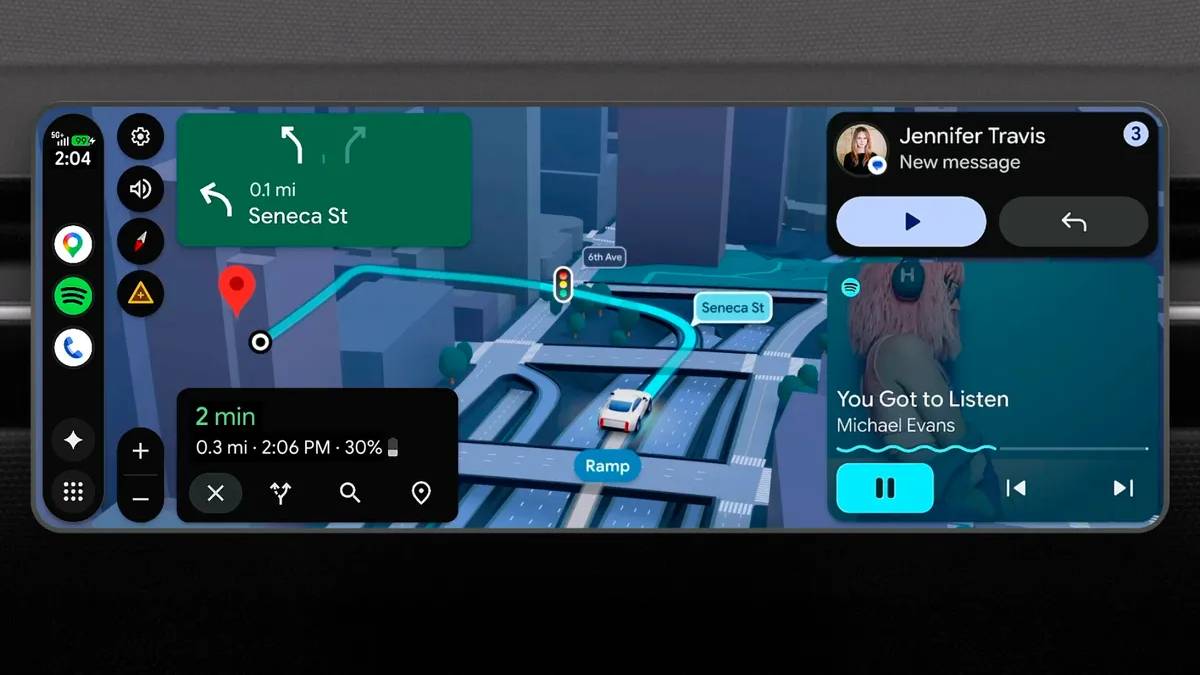
Android Auto's 2026 makeover rips up the platform's rigid, card-based interface in favor of a dynamic, shape-shifting layout that scales seamlessly from a 7-inch square to a 34-inch panoramic ultrawide. The update, first reported by Android Police on Tuesday, May 12, 2026, introduces full 1080p YouTube playback and an immersive maps experience that finally treats the car's display as a canvas rather than a constraint.
Key Facts
- The 2026 redesign introduces a fully adaptive UI that automatically reflows interface elements to match any screen aspect ratio, from portrait to ultrawide 32:9.
- Full HD YouTube playback (1080p) arrives on Android Auto for the first time, ending years of resolution caps that limited video to 720p.
- Google is implementing a new "Immersive Maps" mode that expands navigation to fill the entire display, with turn-by-turn directions overlaid directly on the map rather than in a separate panel.
- The update supports multi-window multitasking with up to three simultaneous app panels on large screens, such as maps, music, and messaging side by side.
- Gesture-based controls are being standardized, including swipe-to-dismiss notifications and pinch-to-zoom on maps, regardless of the vehicle's native input method.
- The overhaul is expected to ship as a server-side update to Android Auto 12.0 or later, meaning it will not require a new phone or car purchase.
- The update aligns with Google's broader "Matter for Cars" initiative, aiming to unify the in-car experience across Android Auto, Automotive OS, and third-party infotainment systems.
Breaking It Down
The 2026 Android Auto redesign solves a problem that has plagued the platform since its 2015 debut: the assumption that every car screen is a 7-inch landscape rectangle. As automakers have stuffed vehicles with displays ranging from Tesla's 17-inch portrait tablet to Mercedes' 56-inch Hyperscreen, Android Auto's rigid layout has looked increasingly amateurish. The new adaptive UI uses a constraint-based layout engine — similar to what Android phones have used for years — that rearranges app cards, media controls, and navigation into whatever shape the screen provides.
The most striking figure from Android Police's report: Android Auto will support up to three simultaneous app panels on ultrawide displays, compared to the current maximum of two in split-screen mode. This triples the information density for drivers using panoramic screens like BMW's 14.9-inch curved display or Ford's 15.5-inch vertical unit.
The addition of 1080p YouTube is more consequential than it sounds. Google has long restricted Android Auto video resolution to 720p, citing safety concerns about driver distraction. The jump to full HD suggests the company now believes larger, higher-resolution displays can safely render video at native resolution — or that it has developed better driver-distraction detection. For passengers, this means crisp video on the center screen, while drivers still see only navigation and audio controls. The real beneficiary is parked usage: electric vehicle owners who spend 30 minutes at a Supercharger can now watch YouTube at the same quality as their phone or tablet.
Google's "Immersive Maps" mode represents a philosophical shift. Historically, Android Auto treated navigation as one app among many, with maps occupying roughly two-thirds of the screen. The new mode dedicates the entire display to navigation, with turn arrows, lane guidance, and estimated arrival time rendered as translucent overlays. This mirrors what Apple CarPlay has offered since iOS 15, but Google is adding a twist: the maps layer can dynamically shrink to accommodate incoming notifications or media controls, then expand back when the driver dismisses them. The result is a fluid experience that prioritizes navigation without sacrificing access to other functions.
What Comes Next
The 2026 Android Auto overhaul won't arrive all at once. Google is expected to roll out the update in phases, with the adaptive UI launching first on vehicles with Android Automotive OS (built into the car's head unit) before reaching phones running the Android Auto app. Here are the concrete milestones to watch:
-
June 2026 (Google I/O): Google is expected to formally announce the redesign at its annual developer conference, likely alongside the first developer beta for Android Auto 12.0. This is when automakers like Ford, GM, and Volvo will confirm which of their 2027 model-year vehicles will ship with the new interface pre-installed.
-
Q3 2026 (Public Beta): A public beta program will open for Android Auto users with compatible phones and vehicles. This phase will test the adaptive UI on a range of screen sizes, from aftermarket Pioneer units to factory-installed 12.3-inch displays in BMWs and Mercedes.
-
Q4 2026 (Wide Release): The stable update is expected to roll out to all Android Auto users, delivered as a server-side update to the Android Auto app on phones. No new hardware required — any vehicle currently compatible with Android Auto should support the new interface.
-
2027 (Automaker Integration): The first vehicles with the new Android Auto interface baked into their infotainment systems will arrive as 2027 model-year cars. These vehicles will likely feature the "Matter for Cars" compatibility badge, guaranteeing a consistent experience across Android Auto and the car's native software.
The Bigger Picture
This update sits at the intersection of two major trends: the screen-ification of the car interior and Google's war for in-car dominance. Automakers are now installing displays that rival home televisions — the Mercedes Hyperscreen packs 56 inches of OLED across the dashboard, while Tesla's 17-inch center display has become an industry benchmark. Android Auto's old interface was designed for an era when 7-inch resistive touchscreens were cutting-edge. The 2026 redesign acknowledges that the car is now a mobile computing environment, not just a navigation accessory.
Simultaneously, this update is Google's answer to Apple CarPlay's "next-generation" experience, announced in 2022 but still largely vaporware. Apple promised a CarPlay that would take over all of a vehicle's screens, including the instrument cluster and climate controls. Google's approach is more pragmatic: rather than trying to replace the entire car's operating system, it's making Android Auto adapt to whatever screens exist. This strategy plays to Google's strength — Android's legendary flexibility across hardware — while avoiding the integration nightmares that have delayed Apple's vision.
The "Matter for Cars" initiative, which underpins this redesign, also signals Google's long-term goal: a unified in-car platform that works whether the car runs Android Automotive OS, a proprietary system, or even Apple CarPlay. By making Android Auto the universal UI layer, Google positions itself as the operating system of the car's infotainment future, regardless of who builds the dashboard.
Key Takeaways
- [Adaptive UI Launch]: Android Auto's 2026 redesign introduces a constraint-based layout that automatically adjusts to any screen shape or size, from 7-inch squares to 34-inch ultrawide displays.
- [1080p YouTube Arrives]: Full HD video playback finally comes to Android Auto, benefiting parked EV owners and passengers while maintaining driver-distraction safeguards.
- [Immersive Maps Overhaul]: A new full-screen navigation mode treats maps as the primary interface, with dynamic overlays for notifications and media controls — matching Apple CarPlay's best feature while adding Google's flexibility.
- [No Hardware Required]: The update ships as a server-side change to the Android Auto app, meaning millions of existing vehicles will gain the new interface without buying a new car or phone.