TL;DR
In the summer of 2024, the Atlanta Dream secretly tested a wearable sensor system that tracks every player's biomechanics, ball handling, and shooting motion in real time during scrimmages — effectively "hacking" the jumper to identify mechanical flaws invisible to the naked eye. This technology, if adopted league-wide, could fundamentally alter how basketball players are scouted, trained, and valued, sparking a new arms race between teams that have the data and those that do not.
What Happened
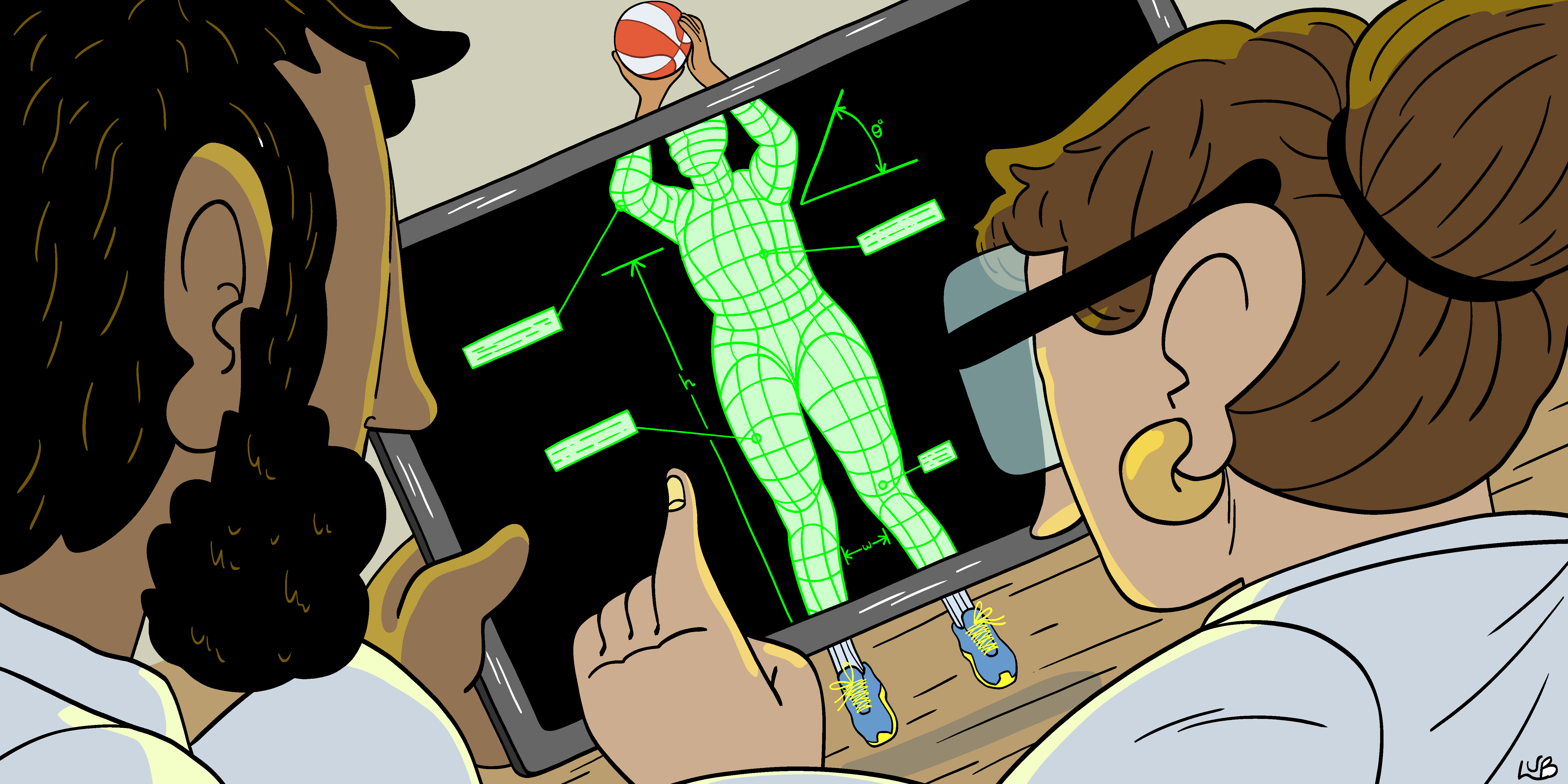
During the WNBA's Olympic break in July 2024, several Atlanta Dream players who were not competing in Paris gathered for a midseason training camp. To any observer, it looked like a routine 3-on-3 scrimmage. In reality, every player was wearing thin, flexible sensor strips embedded in their jerseys and shoes, linked to a central tablet that displayed real-time biomechanical data — shot arc, release angle, hip rotation, foot strike timing, and even muscle fatigue indicators — for every single possession.
Key Facts
- The Atlanta Dream conducted the secret trial during the WNBA's Olympic break in July 2024, with players not on the U.S. national team participating.
- The sensors were developed by a Silicon Valley startup (unnamed in the report) and measured 12 distinct biomechanical metrics per shot attempt, including release height, elbow alignment, and wrist snap velocity.
- Data was streamed to a single tablet courtside, where coaches could see real-time heat maps of each player's shooting efficiency from different zones, updated after every shot.
- The system flagged "micro-flaws" — deviations as small as 2 degrees in release angle — that correlated with a 7–12% drop in shooting accuracy over the course of a game.
- Three players voluntarily adjusted their shooting form mid-scrimmage based on live feedback; two saw immediate improvement in make percentage by the second half of the session.
- The trial was kept completely off the record; no press release, no social media posts, and no public acknowledgment from the WNBA or the Dream until Defector's investigation in May 2026.
- The NBA has been quietly monitoring similar sensor technology since 2023, but the Dream's trial is the first known instance of a professional basketball team using it in a live practice setting.
Breaking It Down
The core insight from the Atlanta Dream's trial is that basketball shooting, long considered an art form honed by muscle memory and instinct, is actually a deeply mechanical process with quantifiable inefficiencies that have been invisible to coaches for decades. The sensors captured data that no film room or scout's eye could detect: the exact millisecond a player's wrist begins to pronate, the precise angle of the elbow at the apex of the jump, and the subtle shift in weight distribution that precedes a miss. This is not about replacing the coach's judgment; it is about augmenting it with a layer of precision that was previously the domain of physics labs, not basketball courts.
The system identified that one player's shooting percentage dropped by 11% in the fourth quarter not because of fatigue, but because her release point drifted 3.4 degrees to the left after 30 minutes of play — a drift no coach had ever noticed, but which the sensors caught on the 47th shot of the scrimmage.
This finding is the kind of granular data point that could reshape player development. For decades, shooting coaches have relied on video review and subjective feel. The Dream's trial suggests that micro-adjustments — correcting a release angle by a few degrees, altering foot placement by half an inch — can produce measurable improvements in a single session. The two players who improved mid-scrimmage did so by making changes that were invisible to everyone else in the gym. The third player who adjusted but did not improve highlights the risk: not every mechanical tweak works, and the data can lead to overcorrection if not paired with sound coaching judgment.
The competitive implications are enormous. If the Dream can identify and fix shooting flaws faster than other teams, they gain a statistical edge in player development, game preparation, and even trade valuation. A player who appears to be a 35% three-point shooter on film might actually be a 42% shooter with a 2-degree release angle correction — a difference that could swing a playoff series. The Silicon Valley startup behind the sensors is now courting other WNBA and NBA teams, and the race to secure exclusive access is already underway.
What Comes Next
The Defector report will accelerate a quiet but fierce competition among professional basketball teams to acquire and deploy this sensor technology. Here are the specific developments to watch:
-
WNBA Commissioner's Office Ruling (Expected Q3 2026): The league will likely issue a formal policy on wearable sensor use during practices and potentially games. Teams are lobbying for unrestricted access, while the players' union is raising concerns about data privacy and whether biomechanical data could be used in contract negotiations.
-
NBA Team Pilot Programs (Fall 2026): At least four NBA teams — the Boston Celtics, Golden State Warriors, San Antonio Spurs, and Oklahoma City Thunder — are reportedly in advanced talks with the same Silicon Valley startup. Expect public announcements of pilot programs during training camps in September and October 2026.
-
Player Union Data Rights Negotiations (Late 2026): The National Basketball Players Association (NBPA) will demand that any biomechanical data collected be owned by the player, not the team, and that it cannot be used to reduce salaries or deny guaranteed contracts. This will be a major bargaining point in the next collective bargaining agreement.
-
Public Demo at NBA Summer League (July 2027): The most likely first public showcase of the technology will be at the 2027 NBA Summer League in Las Vegas, where a team will allow limited media access to the sensor data during scrimmages, marking the transition from secret trial to open competitive tool.
The Bigger Picture
This story sits at the intersection of two broader trends: biomechanical analytics and wearable sports technology. The same sensor miniaturization that powers WHOOP bands and Apple Watches is now being applied at a granular level to specific athletic movements — not just heart rate and steps, but the exact physics of a jump shot. This is part of a larger shift in professional sports from "what happened" (box scores) to "why it happened" (biomechanics).
The second trend is the data arms race in professional sports. Teams that can collect, analyze, and act on proprietary data faster than their rivals gain a compounding advantage. The Houston Rockets pioneered this with three-point analytics a decade ago; now every team has a analytics department. The next frontier is real-time biomechanical feedback, and the Atlanta Dream's secret trial shows that the race has already begun — even if most fans, and most teams, have no idea it is happening.
Key Takeaways
- [Atlanta Dream Secret Trial]: The team tested real-time biomechanical sensors during a 2024 scrimmage, proving that shooting flaws invisible to the naked eye can be measured and corrected in a single session.
- [Micro-Adjustment Impact]: A 2-degree release angle deviation correlated with a 7–12% drop in accuracy, and two players improved immediately after adjusting based on live sensor data.
- [Data Ownership Battle]: The WNBA and NBA players' unions will fight for control over biomechanical data, which could be used in contract negotiations and player valuation.
- [Competitive Arms Race]: Multiple NBA teams are expected to launch pilot programs by fall 2026, and the first public demo will likely occur at NBA Summer League in July 2027.