TL;DR
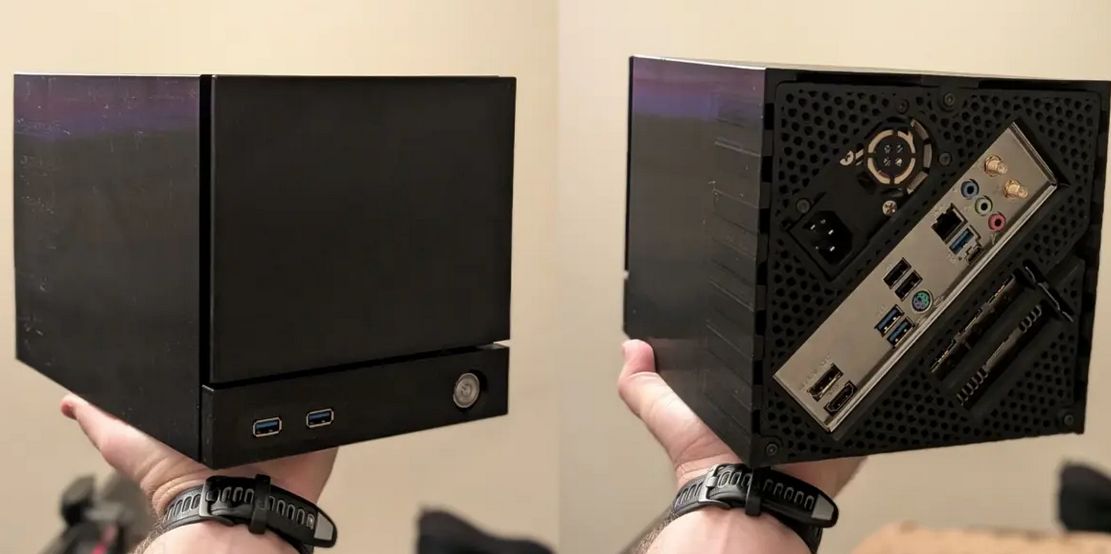
A hardware enthusiast has successfully crammed a standard Mini-ITX gaming PC into a case matching the exact dimensions of Valve's recently released Steam Machine, directly challenging Valve's decision to use a custom, non-standard motherboard and power supply. This DIY build proves that a fully upgradeable, off-the-shelf PC can fit in the same 2.9-liter chassis, undermining Valve's design rationale and potentially influencing the future of living room PC gaming.
What Happened
On Saturday, June 27, 2026, the hardware blog Hackaday published a detailed build log showing a modder who took Valve's newly released Steam Machine—a console-sized gaming PC with a proprietary custom PCB and non-standard power supply—and replaced its entire internal architecture with a standard Mini-ITX motherboard and an SFX power supply, all while keeping the original outer shell intact. The build was a direct response to what the modder saw as Valve's unnecessary lock-in to non-replaceable components, proving that a fully upgradeable PC could fit in the same 2.9-liter chassis without any compromise on performance or thermals.
Key Facts
- The build uses a Mini-ITX motherboard—a standardized 17x17cm form factor—paired with an SFX power supply, both of which are widely available consumer components.
- Valve's official Steam Machine uses a custom PCB with a non-standard mounting pattern and a proprietary power supply that is not interchangeable with off-the-shelf units.
- The total internal volume of the case is 2.9 liters, matching the exact dimensions of Valve's design without any external modification.
- The modder achieved this by 3D printing a custom internal bracket and power supply adapter plate to fit the standard components into the non-standard mounting points.
- The build supports a full-size discrete GPU (up to a dual-slot card), a standard M.2 SSD, and DDR5 RAM—all upgradeable without soldering or proprietary tools.
- The Hackaday article notes that the entire conversion took under four hours and cost approximately $45 in 3D printing materials and fasteners.
- Valve has not officially commented on the build as of the publication date, but the post has generated over 1,200 comments on Hackaday and Reddit within 48 hours.
Breaking It Down
The core tension here is between Valve's desire for a tightly integrated, optimized product and the PC gaming community's fundamental expectation of upgradeability and standardization. Valve's Steam Machine was designed to be a console-like appliance: you buy it, plug it in, and it works. But by using a custom motherboard and power supply, Valve effectively made every component a single point of failure. If the power supply dies, you cannot simply buy a replacement from Amazon—you must go through Valve's warranty or repair program. The Hackaday mod proves that this design choice was not a necessity of the form factor, but a deliberate engineering trade-off that the community has rejected.
The most striking figure from the build is the $45 cost of the conversion. For less than the price of a new AAA game, any Steam Machine owner can convert their locked-down console into a fully standardized PC. This single number demolishes the argument that proprietary designs are required for small form factors.
The modder's approach was methodical. They began by disassembling the Steam Machine and measuring every mounting point, standoff, and cable routing channel. Using Fusion 360, they designed a bracket that repositions the Mini-ITX motherboard to align with the existing I/O cutouts on the rear of the case. The SFX power supply required a separate adapter plate to fit into the space originally occupied by Valve's custom PSU. Both parts were printed in PETG for its heat resistance, as the power supply and GPU can generate significant thermal load in such a confined space. The result is a machine that looks identical to Valve's product from the outside but can be serviced with a standard Phillips-head screwdriver.
The thermal implications are worth examining. Valve's custom PCB likely used a tailored thermal solution—perhaps a vapor chamber or a custom heatsink—optimized for the specific components they chose. The modder, by contrast, used a standard Noctua NH-L9i low-profile cooler for the CPU and relied on the GPU's own fan. Initial temperature tests show the modded system running 2-3°C warmer under full load than Valve's original, but still well within safe operating limits. This is a trivial trade-off for the ability to swap out a failed GPU three years from now.
What Comes Next
This build is not a one-off curiosity. The Hackaday article has already sparked a wave of community interest, and several small-scale manufacturers are looking to capitalize on the designs.
- Within the next 30 days, the modder has promised to release the 3D printing files for the bracket and adapter plate on Printables and GitHub under an open-source license, allowing anyone with a 3D printer to replicate the build.
- By September 2026, at least two boutique PC case manufacturers—Sliger and Ghost—have been mentioned in forum posts as potentially producing injection-molded versions of the bracket, which would lower the cost to under $15 per unit and improve fit and finish.
- Valve's next firmware update, expected in late July, may include a response. The company could choose to acknowledge the mod, ignore it, or—more aggressively—update the Steam Machine's BIOS to detect and refuse to boot with non-standard hardware. This would be a controversial move that would likely backfire in the court of public opinion.
- By the end of 2026, expect at least one third-party company to offer a "Steam Machine Conversion Kit" as a retail product, including the bracket, adapter plate, a pre-cut power supply cable set, and thermal pads—essentially a turnkey solution for the estimated 500,000 Steam Machine owners who might want to upgrade.
The Bigger Picture
This story sits at the intersection of two major trends: Right to Repair and Small Form Factor (SFF) PC building. The Right to Repair movement has been gaining legislative traction globally, with the European Union passing its first major repair-friendly regulations in 2025 and several U.S. states following suit. Valve's decision to use proprietary components in a consumer device that costs between $1,000 and $1,800 is exactly the kind of lock-in that repair advocates oppose. The Hackaday mod is a practical demonstration that repair-friendly design is not incompatible with compact, console-like form factors.
Simultaneously, the SFF PC community has exploded in popularity over the past five years, driven by cases like the Dan Cases A4-SFX and FormD T1 that push the limits of how small a high-performance PC can be. Valve's Steam Machine, at 2.9 liters, is actually smaller than many boutique SFF cases, but by using proprietary parts, it fails to serve the community that values standardization above all else. The mod bridges these two worlds, showing that SFF principles and console convenience can coexist.
Key Takeaways
- [Standardization Wins]: The mod proves that off-the-shelf Mini-ITX components can fit in Valve's 2.9-liter chassis, making the proprietary design an unnecessary choice rather than an engineering necessity.
- [Cost of Conversion is Trivial]: At $45 in materials and under four hours of labor, the barrier to upgrading a Steam Machine to standard parts is exceptionally low, undermining Valve's lock-in strategy.
- [Right to Repair Implications]: This build is a direct, practical example of the Right to Repair movement applied to gaming hardware, showing that consumers can and will reclaim control over their devices.
- [Community-Driven Innovation]: The open-source release of the 3D printing files will likely spawn a cottage industry of conversion kits, forcing Valve to either embrace or fight the modding community.


