TL;DR
Google has launched a new "Notebooks" feature for its Gemini AI, moving it beyond a simple chatbot into a persistent, organized workspace. This directly addresses a core user frustration with AI assistants—the loss of context in long chat histories—and positions Gemini as a more serious productivity tool against competitors like Microsoft Copilot and Anthropic's Claude.
What Happened
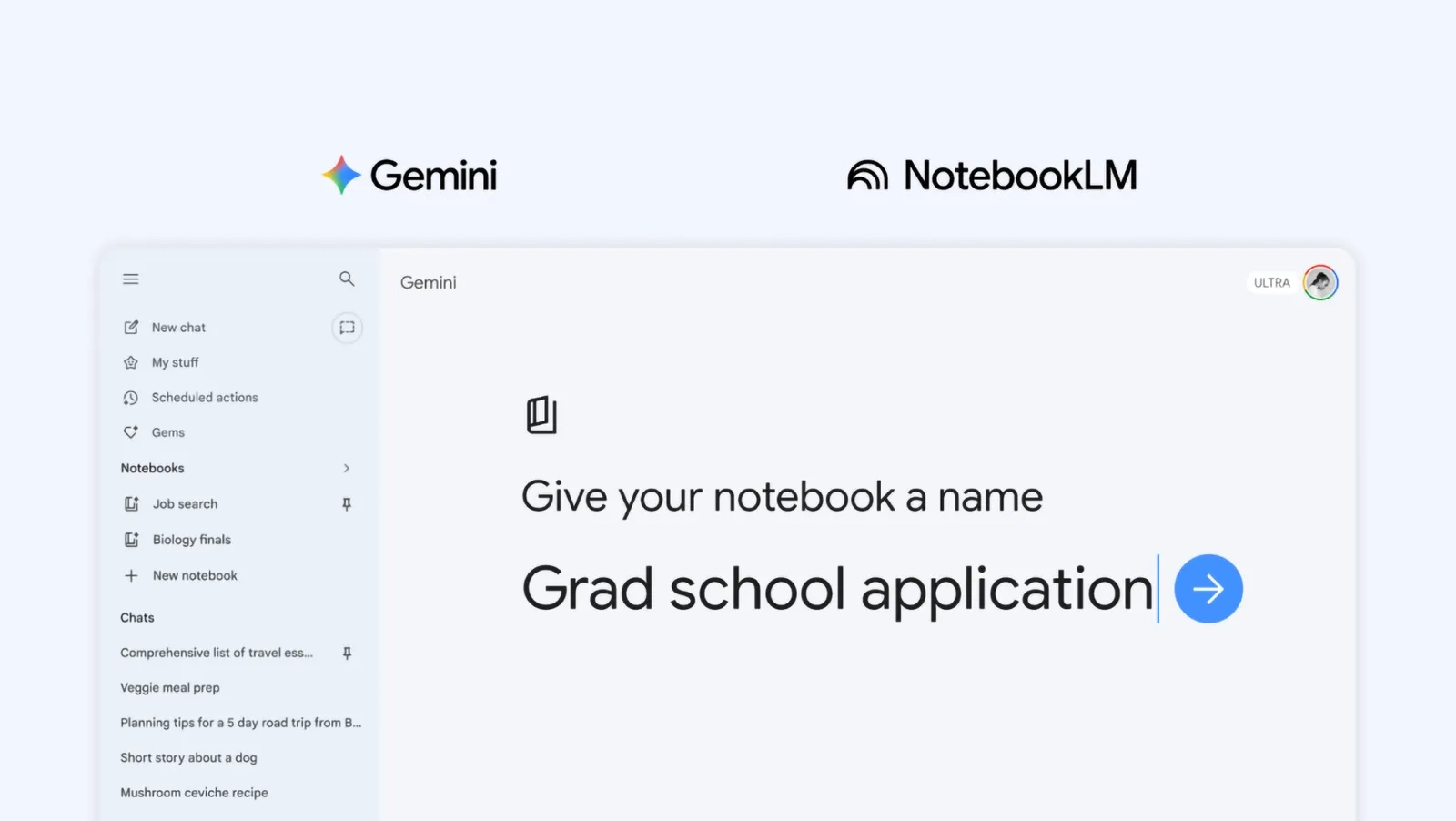
Google has fundamentally redefined its flagship AI product, Gemini, by launching a new "Notebooks" feature that transforms ephemeral chats into structured, persistent workspaces. This update, spotted in the Gemini app, directly tackles the common and frustrating experience of scrolling back through weeks of chat history to find a specific piece of information, a problem that has plagued conversational AI since its inception.
Key Facts
- The new feature, called Notebooks, was identified within the Gemini application interface on Monday, April 13, 2026.
- Notebooks function as synced, persistent workspaces that exist independently of linear chat history, allowing users to organize prompts, code, and research insights.
- The development directly addresses the "context loss" problem, where valuable information becomes buried and difficult to retrieve in endless chat logs.
- This move positions Gemini against productivity-focused AI features from competitors, including Microsoft’s Copilot in Loop and Anthropic’s Claude Projects.
- The feature represents a strategic shift for Google, evolving Gemini from a query-and-answer tool into a centralized knowledge hub.
- Integration is expected with Google’s core Workspace apps like Docs, Sheets, and Drive, though the full scope of these connections is not yet public.
- The rollout follows a period of intense competition in the AI agent and workspace arena, where capabilities for long-term, complex project management are becoming key differentiators.
Breaking It Down
Google’s introduction of Notebooks is not a minor feature update but a strategic pivot that acknowledges a fundamental limitation of the current chatbot paradigm. By creating dedicated spaces for ongoing work, Google is betting that the future of AI assistance lies not in isolated conversations but in continuous, contextual collaboration. This transforms Gemini from a tool you visit for a quick answer into a workspace you inhabit for deep work, increasing user dependency and session length.
The most significant implication is the potential lock-in effect: as users build a library of proprietary research, code snippets, and project outlines in Gemini Notebooks, migrating to a competing AI platform becomes exponentially more difficult.
This creates a powerful data moat for Google. A user’s accumulated knowledge within Gemini Notebooks—be it market analysis for a startup, draft chapters of a novel, or a repository of debugging solutions—represents significant invested effort. The switching cost to another AI that cannot import or understand this structured context becomes a major barrier. This strategy mirrors how Google’s ecosystem (Gmail, Photos, Drive) retains users through accumulated data, now applied to the generative AI layer.
The feature is a direct counter to similar architectural moves by rivals. Anthropic’s Claude.ai has seen strong adoption of its "Projects" feature, which offers a 200K context window for persistent documents, while Microsoft Copilot is deeply integrated into the Loop collaborative canvas. Google’s Notebooks must therefore not only match but exceed these implementations, likely through superior integration with the over 3 billion user accounts in its ecosystem. The success of Notebooks will hinge on its ability to seamlessly pull data from Gmail, Calendar, and Docs, and push refined content back into them, making Gemini the intelligent connective tissue of Google Workspace.
Furthermore, this signals Google’s focus on the enterprise and prosumer market. Casual users might tolerate digging through chat history, but professionals and businesses require organization, audit trails, and knowledge retention. Notebooks provide a framework for team collaboration, version control for AI-generated content, and a structured way to manage complex, multi-step AI "agents" or workflows. This is where the real revenue battle with Microsoft’s Copilot for 365 is being fought.
What Comes Next
The initial discovery of the Notebooks UI is just the beginning. Google will now enter a critical phase of public testing, refinement, and integration that will define the feature's ultimate impact.
- A staged rollout and feature clarification: Expect an official announcement from Google I/O 2026 or sooner, detailing access timelines (likely for Gemini Advanced subscribers first), the exact structure of notebooks (folder hierarchies, tagging), and crucially, their default context window size. Will each notebook have a dedicated, expandable context, or will it tap into Gemini’s standard limits?
- Integration roadmap with Workspace: The true test is seamless connectivity. Watch for announcements on whether Notebooks can: directly cite and pull text from a Google Doc; create a Sheet from a data analysis prompt; or schedule tasks in Calendar from a meeting summary stored in a notebook. The depth of these two-way integrations will be a key performance indicator.
- Third-party and API expansion: For developers, the question is whether Notebooks will be accessible via the Gemini API. This could allow third-party apps to read from or write to a user’s notebooks, creating a new class of integrated AI-powered tools. Google’s decision here will either open an ecosystem or keep Notebooks a walled garden.
- Monetization and tier strategy: Google will need to define the limits of the free tier. Likely, factors like the number of notebooks, collaborators per notebook, or total stored context will be gated behind the Gemini Advanced subscription, turning Notebooks into a major driver for premium conversions.
The Bigger Picture
Gemini Notebooks is a concrete manifestation of two dominant trends reshaping the technology landscape. First, the shift from AI as a Feature to AI as an Operating System. Companies are no longer content to offer AI as a plug-in; they are racing to build the foundational layer—the AI-native environment—where all work begins. Google, Microsoft, and Apple are each attempting to make their AI the central orchestrator of the user's digital experience, with persistent memory and agency.
Second, it highlights the critical importance of Stateful vs. Stateless AI. The first wave of chatbots was stateless; each session was largely independent. The new battleground is statefulness: an AI that remembers, learns, and builds upon all prior interactions. Notebooks are Google’s framework for maintaining that state in a user-friendly way. This evolution is essential for developing truly personalized AI agents that can manage long-term projects, from planning a vacation to writing software, without needing constant re-briefing.
Key Takeaways
- Strategic Pivot: Google is aggressively repositioning Gemini from a conversational chatbot into a persistent, organized productivity workspace to increase user stickiness and compete for enterprise contracts.
- Solving Context Loss: The Notebooks feature directly attacks a primary user pain point—the inability to easily retrieve and build upon past AI interactions—which has hindered the adoption of AI for complex, ongoing work.
- Ecosystem Lock-In: By encouraging users to store valuable, structured knowledge within Gemini, Google is creating significant switching costs, leveraging user-generated data to build a defensible moat in the competitive AI landscape.
- Enterprise Focus: This development underscores the intense competition in the B2B and prosumer AI market, where capabilities for project management, collaboration, and knowledge retention are now essential table stakes.