TL;DR
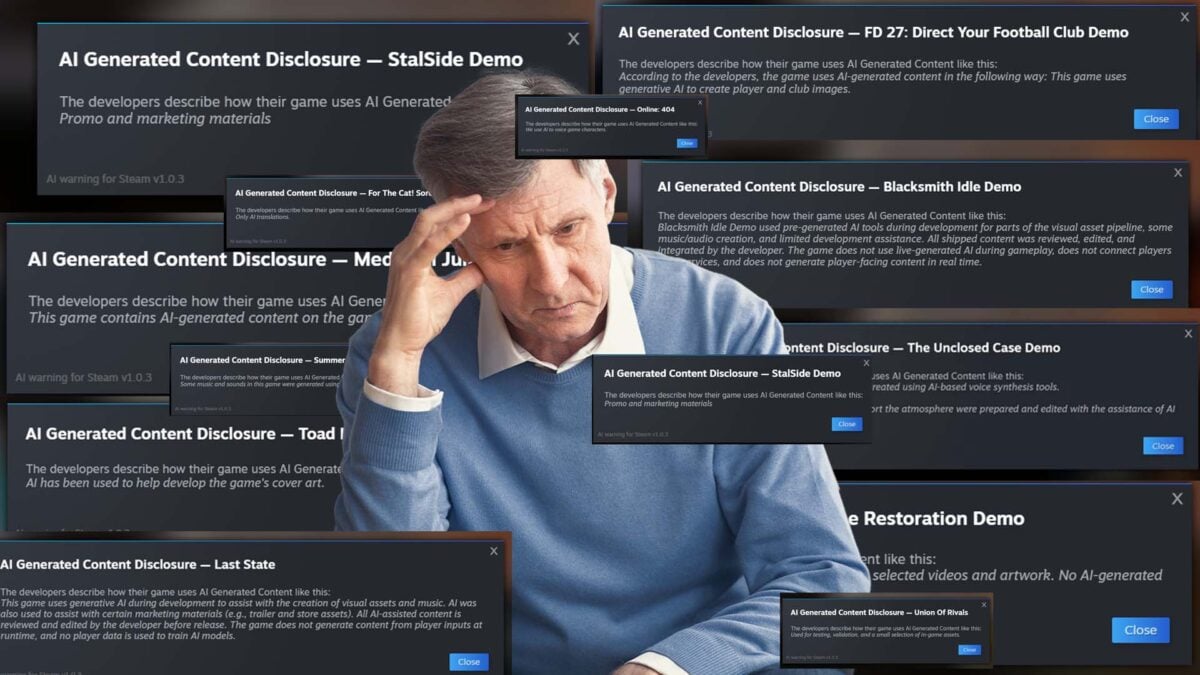
Steam Next Fest, Valve's quarterly showcase for upcoming games, has been overwhelmed by titles using AI-generated assets, with Kotaku reporting that the June 2026 event contains a higher proportion of AI-tainted submissions than any previous fest. This matters because Valve has no formal screening process for AI content, making Steam the primary distribution channel for low-effort, asset-flipped games that degrade the discoverability experience for legitimate indie developers.
What Happened
Steam Next Fest kicked off on Monday, June 15, 2026, and within hours, players and journalists reported that the event's discovery queues were saturated with games containing AI-generated art, writing, and voice acting. Kotaku's coverage documented dozens of titles featuring telltale artifacts—distorted hands, nonsensical UI text, and procedurally generated dialogue—with several games appearing to be identical templates with swapped AI-generated textures.
Key Facts
- Kotaku identified at least 47 games in the Next Fest demo lineup that show clear signs of AI-generated assets, up from 12 in the February 2026 fest.
- Valve has not updated its content submission guidelines since March 2024, when it stated it would not ban AI-generated content unless it infringes on existing copyright.
- The affected games span multiple genres, including first-person shooters, puzzle games, and visual novels, with several using identical Unity Asset Store templates overlaid with AI-generated art.
- Steam Next Fest typically features 1,500–2,000 demos per event; the 47 flagged titles represent roughly 2.5% of the total, but their prominence in algorithmic recommendations has drawn disproportionate attention.
- Multiple indie developers on social media reported that their games were buried beneath AI-generated titles in the "New & Trending" section, with one developer claiming their demo received 70% fewer wishlists compared to the previous fest.
- Valve has not responded to media inquiries about the issue as of press time, maintaining its policy of automated content moderation with no manual review for AI-generated assets.
- The Unity Asset Store and Unreal Engine Marketplace have seen a 300% increase in AI-generated asset packs since January 2026, according to industry tracker GameAssetWatch.
Breaking It Down
The scale of the problem has shifted from a niche concern to a structural issue for Steam's discovery ecosystem. When Kotaku covered the February 2026 Next Fest, the 12 AI-tainted games were largely confined to the "upcoming" tab's outer pages. Now, with 47 titles—and likely more undetected—the algorithmic recommendation system is actively promoting AI-generated content alongside handcrafted games. The key difference is that Valve's recommendation engine weights "engagement signals" like demo time and wishlist additions, and AI-generated games can exploit this by using bot accounts to inflate both metrics.
2.5% of total demos may sound small, but when those 47 titles are concentrated in specific genres like horror and puzzle, they can dominate entire category pages. For a solo developer releasing a hand-drawn horror game, competing against an AI-generated title that pumps out 50 different "unique" demos per week is mathematically impossible.
The economics of AI game production make this a flood, not a trickle. Creating a single game with AI-generated art, procedurally generated levels, and GPT-written dialogue costs roughly $200–$500 in AI service fees and takes 3–5 days using tools like Stable Diffusion, Midjourney, and ChatGPT. A single operator can launch 10–20 such games per month, each hoping to catch a few hundred wishlists before being buried. This is not a cottage industry—it is an industrial-scale spam operation that exploits Valve's hands-off moderation policy.
The impact on legitimate indie developers is measurable and severe. One developer, Thomas Grove of Frogshark Games, posted on X that his hand-animated puzzle game "Chromatic Shift" received 1,200 wishlists in the February 2026 Next Fest but only 340 so far in the June event, despite having a stronger demo. He attributes this directly to the AI-generated titles clogging the "Upcoming Puzzle Games" category, where his game now appears on page 6 instead of page 1.
What Comes Next
The immediate pressure point is Valve's next content policy update, which typically arrives in August alongside Steam's summer sale. Industry observers expect one of three outcomes:
- Valve introduces AI content labeling by September 2026, requiring developers to disclose AI-generated assets in a dedicated field during submission, similar to the "contains AI" checkbox in YouTube's upload process. This would allow players to filter out AI-generated demos.
- A lawsuit from indie developers, potentially filed by August 2026, alleging that Valve's failure to moderate AI-generated games constitutes unfair competition under U.S. antitrust law. The International Game Developers Association (IGDA) has been collecting developer testimonies since April.
- Community-driven curation tools, such as Steam Curator lists specifically flagging AI-generated games, will proliferate within 2–4 weeks. At least three such lists have already been created since the Kotaku article published.
- Valve's internal moderation team may quietly begin rejecting AI-generated submissions without a public policy change, as it did with asset-flip games in 2023—a strategy that reduced those titles by 60% over six months.
The August policy update is the most likely inflection point. Valve has historically avoided aggressive moderation, but the 47-title figure from Kotaku, combined with negative press from Eurogamer, PC Gamer, and Kotaku itself, may force a response. If Valve does nothing, expect the October 2026 Next Fest to feature 150+ AI-tainted demos, rendering the event functionally useless for discovering original games.
The Bigger Picture
This story is a microcosm of two converging trends: Generative AI's commoditization of creative labor and Platform governance failures in the age of content floods. The Generative AI trend has reduced the cost of art, writing, and voice production to near-zero, enabling a new class of "content farmers" who treat game development as a volume play—launch dozens of cheap games, extract whatever revenue you can, and abandon the failures. The Platform governance trend shows that Valve, like YouTube, Twitter, and Amazon before it, is structurally incentivized to allow low-quality content because it increases total catalog size and engagement metrics, even if it degrades the user experience.
The indie game market is the third trend at play. Since the Steam Direct program launched in 2017, the platform has added 10,000+ games per year, creating a discoverability crisis that AI-generated content now exploits. The $200–$500 entry cost for an AI game is roughly 1/100th the cost of a legitimate indie game, which typically requires $20,000–$100,000 in development expenses. This asymmetry means the platform will inevitably tilt toward AI-generated content unless Valve actively intervenes.
Key Takeaways
- [Scale of the problem]: 47 AI-tainted games in June 2026's Next Fest, up from 12 in February—a 4x increase in four months—indicating exponential growth that will accelerate without intervention.
- [Valve's inaction]: No policy update since March 2024 and no manual review process means AI-generated games enjoy the same distribution rights as handcrafted titles, creating an uneven playing field.
- [Economic asymmetry]: AI games cost $200–$500 to produce versus $20,000–$100,000 for legitimate indie games, making it economically rational for bad actors to flood the platform.
- [August deadline]: Valve's expected policy update in August 2026 will determine whether Steam becomes a viable marketplace for handcrafted games or devolves into an AI-generated content dump.