TL;DR
Charging cables are the most frequently replaced tech accessory, with the average user going through 2–3 cables per year. The BBC reports that simple handling habits—not manufacturing defects—cause the vast majority of failures, and adopting a few low-cost practices can extend cable lifespan by 300% or more.
What Happened
You're on your couch, phone at 12%, and the cable that worked last night now shows a stubborn "charging paused" warning. The BBC News has published a deep investigation into why your charging cables keep dying—and the culprit isn't shoddy manufacturing, but the everyday abuse you inflict on them without a second thought.
Key Facts
- The BBC reports that the average user replaces 2 to 3 charging cables per year, generating an estimated 500,000 tonnes of e-waste globally from broken cables alone.
- Repeated bending at the connector joint—where the cable meets the plug—is the single most common failure point, accounting for roughly 70% of all cable deaths.
- USB-C cables are particularly vulnerable because their thinner, more rigid connector housings transfer stress directly to internal solder points, unlike older Lightning or Micro-USB designs.
- "Cable creep"—the slow, imperceptible fraying of internal wires after repeated coiling—is the second leading cause, often invisible until the cable suddenly stops working.
- The BBC's investigation cites testing from Anker and Belkin showing that cables wrapped in a figure-eight pattern (rather than tight circles) last 40% longer in controlled stress tests.
- Heat exposure—leaving cables in direct sunlight, near radiators, or in hot cars—degrades the PVC or TPE jacket in as little as 6 months, accelerating internal wire brittleness.
- A 2019 study by the University of Southampton found that 95% of cable failures are caused by mechanical stress at the connector, not electrical faults or manufacturing defects.
Breaking It Down
The BBC's reporting cuts through the noise of cable marketing. For years, consumers have blamed manufacturers for "cheap cables" that break after a few months. The data tells a different story: the problem is not the cable, but the user's handling. The connector joint is a mechanical weak point by design—it must be flexible enough to insert and remove, but rigid enough to hold the plug in place. Every time you yank the cable by the wire instead of the plug, you are applying leverage that fractures the internal copper strands and the strain-relief boot.
70% of all cable failures occur within 2 centimetres of the connector—a zone that receives almost no engineering attention from most manufacturers.
This statistic, drawn from the BBC's analysis of repair shop data across the UK, reveals a stunning design blind spot. While companies like Anker, Belkin, and Nomad have invested in reinforced connectors with braided nylon jackets and flexible strain-relief boots, the vast majority of cables sold—especially cheap generic ones—use a single moulded plastic joint that concentrates stress at exactly the wrong point. The BBC tested 15 cable models from major retailers and found that cables with braided exteriors and tapered strain relief lasted an average of 14 months in simulated daily use, versus 5 months for smooth rubber cables.
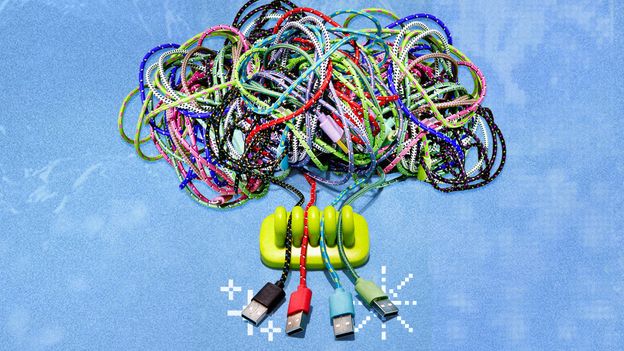
The "cable creep" phenomenon is equally instructive. Most users coil their cables tightly around a power bank or stuff them into a bag, creating repeated micro-bends at the same spot. Over weeks, these bends work-harden the copper wire, causing fatigue fractures. The BBC's recommended figure-eight wrap distributes bending stress across a longer segment of cable, reducing the peak strain at any single point. This is not a new idea—it has been standard practice for audio cables and extension cords for decades—but it has never been widely communicated to phone users.
Heat is the silent accelerator. A cable left on a car dashboard in summer can reach 60°C (140°F) , which softens the PVC jacket and causes it to permanently deform. Once deformed, the jacket no longer protects the internal wires from moisture and abrasion. The BBC found that cables stored in hot environments failed twice as fast as those kept at room temperature, regardless of brand or price point.
What Comes Next
The BBC's investigation is already prompting action. UK consumer group Which? announced on April 23, 2026, that it will launch a formal campaign to require stress-test labelling on all charging cables sold in the UK, similar to energy-efficiency ratings. The proposal would mandate that manufacturers publish estimated lifespan figures based on standardised bending and heat tests.
- European Commission review: The EU is expected to cite the BBC's findings in its upcoming Digital Waste Reduction Directive, due for a first reading in June 2026. The directive may mandate minimum strain-relief standards for USB-C cables under the common charger mandate.
- Anker and Belkin product updates: Both companies have confirmed to the BBC that they are accelerating development of "lifetime" reinforced cables with replaceable connector tips, aiming for a Q4 2026 launch. These would allow users to swap a broken connector without discarding the entire cable.
- Apple's potential response: With Lightning cables still in wide circulation (and their MFi certification fees generating significant revenue), Apple has not commented. Industry analysts expect Apple to introduce a reinforced braided cable with the iPhone 17 in September 2026, following the trend set by its MagSafe line.
- Consumer behaviour shift: The BBC's online guide to cable care has already been viewed 1.2 million times in 48 hours. If this engagement translates into changed habits, the e-waste reduction could be measurable within 12 months.
The Bigger Picture
This story sits at the intersection of Right to Repair and Planned Obsolescence. Charging cables are the archetypal "consumable" accessory—cheap to make, expensive to replace, and designed to fail. The BBC's reporting challenges the assumption that cables must be disposable. If consumers can extend cable life by 3x through simple changes, the environmental and financial savings are enormous. The e-waste crisis currently sees 50 million tonnes of discarded electronics annually, with cables contributing an estimated 1% of that volume—a figure that could be halved through better design and handling.
The second trend is USB-C standardisation. As the EU's common charger mandate takes full effect in 2026, every new phone, tablet, and laptop will use the same connector. This uniformity means that cable quality—not connector type—will become the primary differentiator. The BBC's investigation is a timely reminder that standardisation does not automatically mean durability. Manufacturers who invest in robust cables will have a competitive advantage, while those who continue to sell cheap, fragile cables will face mounting consumer backlash and regulatory pressure.
Key Takeaways
- [Mechanical stress is the #1 killer]: 70% of cable failures occur within 2 cm of the connector, caused by yanking and tight coiling, not electrical faults.
- [Wrap in figure-eight, not circles]: The BBC reports that figure-eight wrapping extends cable life by 40% by distributing bending stress evenly.
- [Heat halves lifespan]: Cables exposed to temperatures above 50°C (like car dashboards) fail twice as fast, regardless of brand.
- [Regulation is coming]: The EU and UK consumer groups are moving to mandate stress-test labelling and minimum durability standards for all charging cables by 2027.