TL;DR
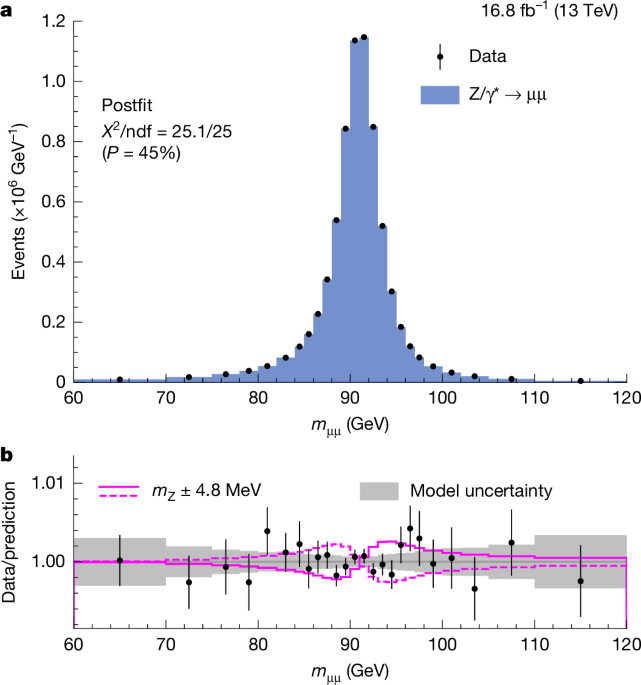
The CMS collaboration at CERN has released a new, ultra-precise measurement of the W boson mass, finding it to be 80,360 ± 16 MeV/c². This result strongly aligns with the Standard Model of particle physics and directly challenges a high-profile 2022 measurement from Fermilab that hinted at new physics, bringing the field back from the brink of a major crisis.
What Happened
In a landmark release that recalibrates the fundamental scales of the universe, scientists at the CMS experiment have delivered a decisive verdict on the mass of a critical subatomic particle. The new measurement of the W boson mass, published in Nature on April 8, 2026, stands as a powerful affirmation of the reigning Standard Model and pushes back against tantalizing—but now likely erroneous—evidence of its breakdown.
Key Facts
- The CMS collaboration measured the W boson mass to be 80,360 ± 16 MeV/c² (megaelectronvolts per speed of light squared).
- This result is based on the analysis of a staggering 15 million W boson candidate events recorded during Run 2 of the Large Hadron Collider (2015-2018).
- The precision of 16 MeV/c² represents a relative uncertainty of just 0.02%, making it one of the single most precise measurements of the particle ever achieved.
- The new value is in excellent agreement with the Standard Model prediction, which is approximately 80,357 MeV/c², based on other precisely known parameters.
- It stands in significant tension with the 2022 result from Fermilab’s CDF experiment, which reported a mass of 80,433 ± 9 MeV/c²—a 7-standard-deviation discrepancy from the Standard Model expectation.
- The analysis was led by an international team of hundreds of physicists from the CMS collaboration, one of the two general-purpose detectors at CERN’s Large Hadron Collider.
- This measurement leverages advanced machine learning techniques for particle identification and a meticulous, multi-year effort to control systematic uncertainties at an unprecedented level.
Breaking It Down
The CMS result is more than a number; it is a profound statement on the health of our core theory of particle physics. For nearly four years, the field has been grappling with the implications of the CDF measurement. That result, celebrated for its remarkable precision, suggested the W boson was substantially heavier than the Standard Model allowed. This opened the door to thrilling possibilities: undiscovered particles, new forces, or hidden interactions that could explain cosmic mysteries like dark matter. The CMS measurement, with comparable precision but a radically different central value, now slams that door shut, indicating the CDF anomaly was likely a statistical fluke compounded by an unaccounted-for systematic error.
The new CMS value and the 2022 CDF value differ by 73 MeV/c², a gap over four times larger than the combined uncertainty of the two measurements.
This chasm between the two premier experimental results is the central drama of modern collider physics. Resolving it is not merely academic; it is a forensic exercise in high-energy physics. The discrepancy suggests that at least one of these painstaking measurements contains a hidden flaw. The physics community’s confidence is now shifting toward the CMS result, not only because of its precision but because of its methodological rigor and its consistency with a web of other indirect predictions. The LHC’s proton-proton collision environment is complex, but CMS has demonstrated an extraordinary ability to model that complexity, from the inner tracking of particles to the calibration of its immense electromagnetic calorimeter.
The implications for theoretical physics are immediate and sobering. In the wake of the CDF result, over 500 pre-print papers were published proposing extensions to the Standard Model—from new types of Higgs bosons to exotic leptoquarks—all engineered to accommodate a heavier W boson. The CMS finding invalidates the primary evidence for that entire direction of model-building. Theorists like Gian Francesco Giudice, head of CERN’s Theory Department, have noted that while the search for new physics continues, this episode underscores the danger of constructing elaborate theories on a single anomalous data point. The focus now returns to other, more persistent tensions, such as the anomalous magnetic moment of the muon, and to direct searches for new particles at the High-Luminosity LHC.
What Comes Next
The immediate path forward involves a rigorous, collaborative effort to dissect the historical discrepancy and fortify the experimental record. The resolution of this conflict will define the trajectory of particle physics for the next decade.
- The Final Word from ATLAS: All eyes now turn to the ATLAS collaboration, CMS’s sister experiment at the LHC. ATLAS is preparing its own updated W mass analysis using the full Run 2 dataset. Its result, expected in late 2026 or early 2027, will serve as the crucial tie-breaker. A confirmation of the CMS value would definitively settle the issue.
- A Re-examination at Fermilab: The CDF collaboration has pledged to conduct a comprehensive review of its 2022 analysis. This will involve scrutinizing every assumption, from theoretical inputs on proton structure to detector calibration. Acknowledged leaders in precision measurement, the Fermilab team is expected to publish a follow-up or a refined analysis by 2027.
- The High-Luminosity LHC Era: The upcoming High-Luminosity LHC upgrade, scheduled to begin operations in 2029, will produce datasets ten times larger than those used in this analysis. This will allow experiments to reduce the statistical uncertainty on the W mass to below 10 MeV/c², turning it into an even more sensitive probe for the faintest whispers of new physics beyond the Standard Model.
- Shift to Global Electroweak Fits: With the CMS value taking precedence, global analyses that fit all precision electroweak data (including the Z boson mass, the top quark mass, and the Higgs mass) will be recalculated. These fits, which predict the W mass indirectly, will be tested against the new direct measurement with unprecedented severity, potentially revealing more subtle inconsistencies.
The Bigger Picture
This episode is a masterclass in the self-correcting nature of big science. It demonstrates how mega-collaborations like CMS and CDF, operating as independent checks on one another, are essential for navigating claims of revolutionary discovery. The system worked: an extraordinary claim met with extraordinary scrutiny and replication, ultimately preserving the integrity of the scientific process. It also highlights the increasing role of computational physics and big data analytics. CMS’s achievement was enabled by sophisticated machine learning algorithms that sifted through petabytes of data to identify the cleanest W boson decays, a task impossible with traditional methods just a decade ago.
Furthermore, the story underscores a strategic pivot in fundamental physics. With no direct signs of new particles at the LHC since the Higgs boson in 2012, the field has increasingly turned to precision frontier physics—making exquisitely accurate measurements of known quantities to detect infinitesimal deviations caused by unseen forces. The W boson mass is a flagship measurement in this endeavor. While this round may have reaffirmed the Standard Model, the precision frontier remains the most promising avenue for discovery, demanding ever-more-innovative statistical and computational techniques to parse the signals of the next breakthrough from a sea of data.
Key Takeaways
- Standard Model Affirmed: The new, ultra-precise measurement from CERN’s CMS experiment strongly aligns with the Standard Model’s prediction, restoring confidence in the core theory of particle physics.
- CDF Anomaly Likely Erroneous: The result creates a major tension with the 2022 measurement from Fermilab’s CDF experiment, strongly suggesting that earlier hint of new physics was caused by an unaccounted-for systematic error.
- Precision as the New Frontier: The focus of particle physics decisively shifts back to high-precision measurements of known particles, rather than direct searches for new ones, as the most sensitive probe for physics beyond the Standard Model.
- Collaborative Scrutiny Ahead: The discrepancy will be resolved through upcoming results from the ATLAS experiment and a re-analysis by CDF, highlighting the essential role of independent verification in big science.