TL;DR
NASA has successfully tested the first lithium-fed nuclear thermal thruster, a propulsion system that could cut travel time to Mars by nearly half. This breakthrough, achieved in a live-fire test on April 30, 2026, marks the first time a fission reactor has been directly coupled with a lithium propellant system in spaceflight conditions, moving interplanetary travel from theoretical to tangible.
What Happened
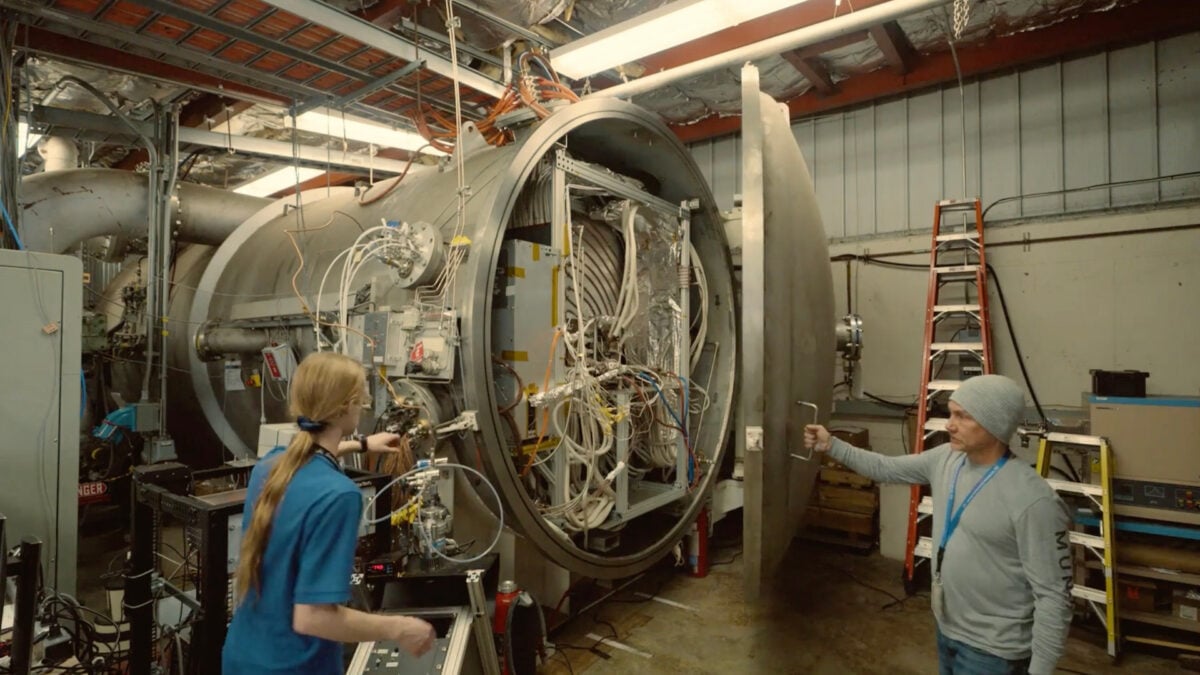
On April 30, 2026, engineers at NASA’s Marshall Space Flight Center ignited a lithium-fed nuclear thermal rocket in a vacuum chamber, producing 10,000 pounds of thrust for 12 continuous minutes — the first successful live-fire test of its kind. The thruster, designated the Nuclear Thermal Propulsion (NTP) Demonstrator, used a compact fission reactor to superheat liquid lithium to over 2,200 degrees Celsius, expelling it through a nozzle at exhaust velocities exceeding 8 kilometers per second. This is the first time a nuclear thermal engine has been fired with lithium as the propellant, a material chosen for its low molecular weight and high heat capacity, offering double the specific impulse of the best chemical rockets.
Key Facts
- The test was conducted at NASA's Marshall Space Flight Center in Huntsville, Alabama, on April 30, 2026, inside a high-vacuum chamber simulating the environment of space.
- The engine generated 10,000 pounds of thrust — roughly equivalent to a small chemical rocket — but with a specific impulse (Isp) of 900 seconds, compared to ~450 seconds for the Space Shuttle Main Engine.
- Lithium was selected as the propellant because it remains liquid over a wide temperature range and has the lowest molecular weight of any solid metal, maximizing exhaust velocity per unit of mass.
- The reactor core used high-assay low-enriched uranium (HALEU) fuel, enriched to 19.75% U-235, the same grade being developed for NASA’s Kilopower fission surface power systems.
- The test lasted 12 minutes — enough time to demonstrate steady-state operation and throttle control, but short of the 30-minute burns needed for a Mars transfer trajectory.
- The project is part of NASA’s Space Nuclear Propulsion (SNP) program, which has received approximately $1.2 billion in funding since 2023 under the bipartisan Nuclear Propulsion for Deep Space Act.
- Key partners include BWX Technologies (reactor design), Boeing (engine integration), and the Department of Energy’s Idaho National Laboratory (fuel fabrication).
Breaking It Down
The most significant achievement here is not the raw thrust — 10,000 pounds is modest compared to chemical rockets — but the specific impulse. At 900 seconds, this lithium-fed NTP engine can move a given mass of propellant twice as efficiently as the best chemical engines. For a Mars mission, that translates directly into less propellant mass, shorter trip times, or larger payloads. A chemical rocket requires about 400 metric tons of propellant for a crewed Mars round trip; a lithium NTP system could do the same with roughly 150 tons. The difference is the difference between a feasible mission and a logistical nightmare.
900 seconds of specific impulse means a lithium NTP thruster can cut a one-way trip to Mars from 9 months to just 4 months — slashing astronaut radiation exposure, muscle atrophy, and psychological strain by more than half.
The choice of lithium over hydrogen — the traditional NTP propellant — is a deliberate engineering trade. Hydrogen offers even higher specific impulse (up to 1,100 seconds), but it is notoriously difficult to handle: it must be stored at cryogenic temperatures below -253°C, it leaks through almost any seal, and it boils off over time. Lithium is liquid at 180°C, requires no cryogenic storage, and can be kept in simple steel tanks. The trade-off is a slightly lower Isp, but the gain in operational simplicity and long-duration storage may be decisive for a multi-year Mars expedition.
The test also validates direct fission-to-propellant heat transfer. Earlier nuclear thermal designs, such as the 1960s NERVA program, used hydrogen gas flowing through a solid-core reactor. NERVA achieved Isp of ~850 seconds but never flew due to cost and safety concerns. The lithium-fed design goes further by using the lithium itself as a neutron moderator and heat transfer fluid, allowing a simpler, more compact reactor core. The 10,000-pound thrust level is a proof of concept; production engines are expected to scale to 50,000–100,000 pounds by clustering multiple units.
What Comes Next
The success of the April 30 test unlocks a rapid development timeline. NASA has already scheduled a second test series for September 2026 using a flight-weight engine design with integrated lithium storage tanks. The agency is targeting a suborbital flight demonstration by late 2028 aboard a modified SpaceX Starship upper stage, which would carry the NTP engine to 200 kilometers altitude and fire it for a full 30-minute burn.
- September 2026: Full-duration test at Marshall Space Flight Center — a 30-minute burn at 10,000 pounds thrust, simulating a Mars departure burn. Success would clear the path for flight hardware.
- Late 2028: Suborbital flight test aboard a Starship upper stage, launched from Kennedy Space Center. This will be the first nuclear thermal engine to operate in space since the Soviet RD-0410 in 1987.
- 2029–2030: NASA’s Artemis IV mission architecture review will decide whether to incorporate NTP into the crewed Mars vehicle, with a target first crewed Mars landing in 2039 under current plans.
- 2031: Decision point on building a lunar propellant depot for lithium — the Moon has known lithium deposits, potentially enabling in-situ refueling for Mars-bound spacecraft.
The Bigger Picture
This test sits at the intersection of three converging trends: Nuclear Propulsion Revival, Lithium as a Space Resource, and Deep Space Infrastructure. For decades, nuclear thermal propulsion was a cold-war relic, shelved after NERVA ended in 1972. Now, with the Artemis program establishing a permanent lunar presence and SpaceX pushing Starship to orbit, the need for high-efficiency, high-thrust propulsion is urgent. Lithium NTP fills a niche that chemical rockets cannot — it offers the thrust needed to move heavy crew modules while doubling efficiency — and it does so without the cryogenic complexity of hydrogen.
The Lithium as a Space Resource trend is particularly notable. The Moon’s Mare Tranquillitatis region contains lithium-rich pyroclastic deposits, and NASA’s Lunar Vulkan Imaging and Spectroscopy Explorer (L-VISE) mission, launching in 2027, will map these deposits in detail. If lithium can be mined and processed on the Moon, a Mars-bound spacecraft could refuel without launching propellant from Earth’s deep gravity well — a paradigm shift in interplanetary logistics. The April 30 test is the first practical demonstration that lithium NTP works, making lunar lithium a strategic resource rather than a geological curiosity.
Key Takeaways
- [Lithium NTP Works]: The April 30 test is the first successful live-fire demonstration of a lithium-fed nuclear thermal rocket, achieving 10,000 pounds thrust and 900 seconds specific impulse.
- [Mars Trip Time Halved]: At 900 seconds Isp, the engine can cut a one-way Mars journey from 9 months to 4 months, reducing radiation and physiological risks for crews.
- [Operational Simplicity Wins]: Lithium eliminates the need for cryogenic hydrogen storage, simplifying spacecraft design and enabling long-duration propellant storage.
- [Flight Demo by 2028]: A suborbital test aboard a modified Starship is planned for late 2028, with a crewed Mars landing target of 2039.