TL;DR
Professional drifter and RTR Vehicles founder Vaughn Gittin Jr. has publicly accused Car and Driver of using artificial intelligence to write a negative review of his company's 800-horsepower Mustang, which tested slower than a standard Mustang GT. This explosive allegation, made on April 8, 2026, strikes at the heart of automotive journalism's credibility during a period of intense industry debate over AI's role in content creation and objective performance testing.
What Happened
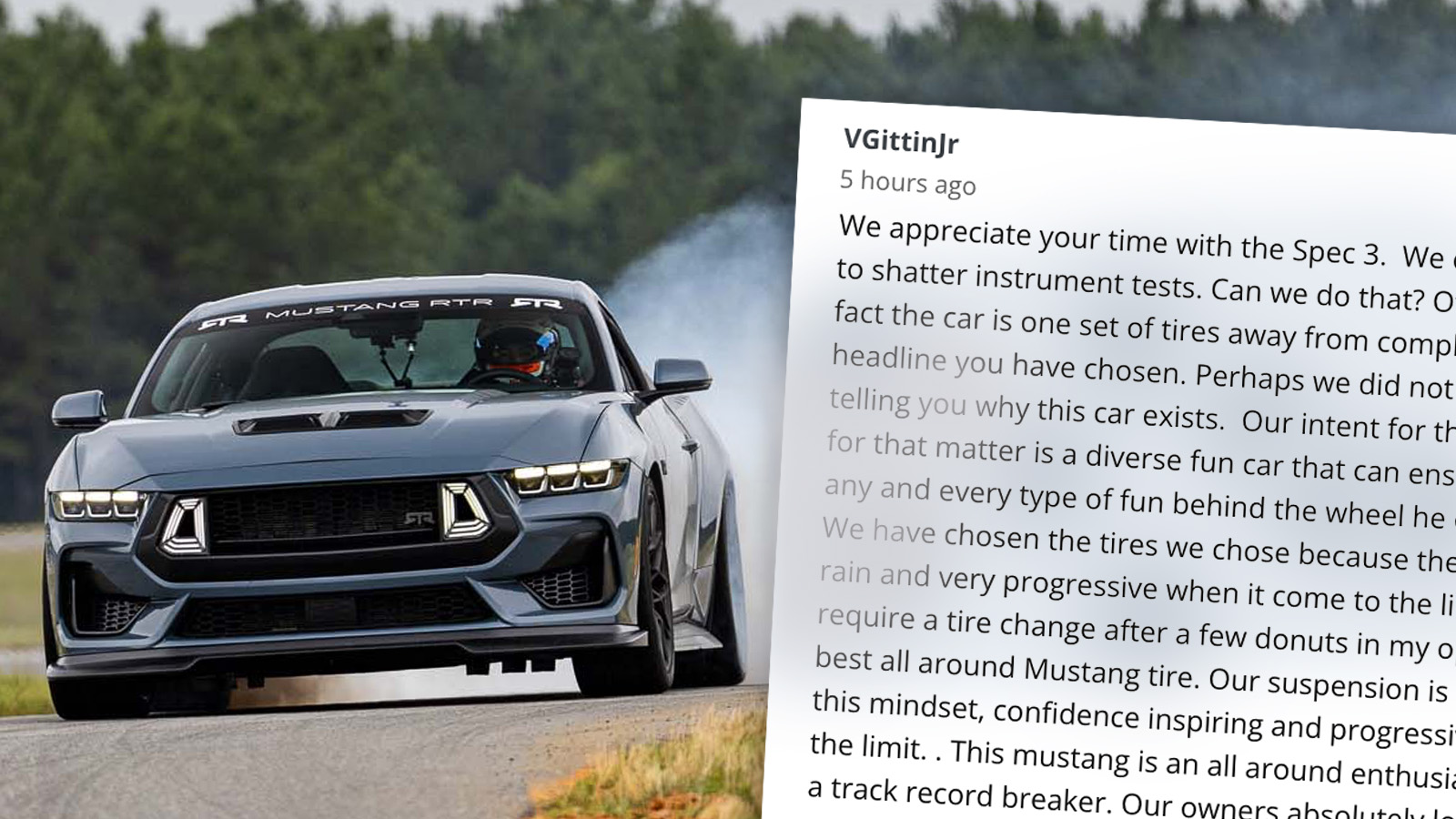
The automotive world ignited on Wednesday when professional drifter and aftermarket tuner Vaughn Gittin Jr. took to social media to seemingly accuse Car and Driver magazine of using AI to author a scathing review. The controversy centers on performance test results for the RTR Vehicles Spec 3 Mustang, a modified, $150,000-plus machine boasting 800 horsepower that, according to the publication's instrumented testing, was outperformed in a straight line by a far less powerful, factory-standard Ford Mustang GT.
Key Facts
- The Accusation: On Wednesday, April 8, 2026, Vaughn Gittin Jr., founder of RTR Vehicles and a champion Formula Drift driver, publicly questioned the authenticity of a Car and Driver review, strongly implying the use of artificial intelligence in its creation.
- The Product: The subject of the review is the RTR Spec 3 Mustang, a heavily modified version of the Ford Mustang Dark Horse, with a supercharged 5.0-liter Coyote V8 producing a claimed 800 horsepower.
- The Performance Discrepancy: Car and Driver's testing recorded a 0-60 mph time of 4.2 seconds and a quarter-mile time of 12.5 seconds at 117 mph for the RTR Spec 3. A standard 2025 Ford Mustang GT with 480 horsepower has been tested by the same outlet to achieve 0-60 mph in 3.9 seconds.
- The Sticker Shock: The RTR Spec 3 carries a price tag exceeding $150,000, more than triple the base price of a Mustang GT and significantly more than a Mustang Dark Horse.
- The Publication: The review was published by Car and Driver, one of the world's most established and respected automotive media brands, founded in 1955.
- The Core Issue: Gittin Jr.'s accusation shifts the focus from potential engineering or tuning explanations for the performance gap to a direct assault on the integrity and human authorship of the journalism itself.
Breaking It Down
This incident is far more than a simple dispute over lap times or horsepower figures. It represents a collision of three powerful forces: the sensitive ego of a brand-building athlete, the entrenched authority of legacy media, and the pervasive new anxiety over AI's role in truth-telling.
At the core of the factual dispute is a staggering performance deficit. The RTR Spec 3's tested numbers are not just slightly off expectations for an 800-horsepower car; they are anomalously poor. This immediately raises technical questions. Was the car in a low-power mode? Was there excessive wheelspin due to tire or tuning issues that the test driver could not manage? Car and Driver's testing procedures are famously rigorous and repeatable, which lends weight to their data. Gittin Jr.'s decision to attack the article's provenance rather than its data suggests either a lack of a ready technical rebuttal or a calculated move to reframe the narrative entirely.
The RTR Spec 3 Mustang, priced over $150,000, was tested to be slower from 0-60 mph than a standard Mustang GT costing less than a third as much.
This single data point is the explosive charge at the center of the story. For customers and enthusiasts, performance per dollar is a sacred metric. A $150,000 "ultimate" Mustang that cannot out-accelerate its showroom-floor sibling fundamentally undermines its value proposition. It transforms the car from a performance bargain into a potential aesthetic or experiential luxury item, a very different product than what is typically marketed by a brand like RTR Vehicles, which is built on a reputation for extreme capability. This puts Vaughn Gittin Jr. in a uniquely defensive position, as the public data directly challenges the competence of his company's engineering and tuning work.
Gittin Jr.'s choice to levy an AI accusation is a distinctly modern tactic. In an era where public trust in media is already fractured, alleging that a review is algorithmically generated is a powerful way to dismiss its contents without engaging with the uncomfortable facts it presents. It implies the review is synthetic, lacking the nuanced feel and experiential authority of a human test driver. For Car and Driver, this is an existential challenge. Their brand equity is built on decades of trustworthy, human-conducted testing. An allegation that they are outsourcing core editorial judgment to AI strikes at their most valuable asset: credibility.
What Comes Next
The immediate fallout and subsequent developments will test the resilience of both the media outlet and the manufacturer.
- Formal Responses: The industry awaits an official, detailed statement from Hearst Magazines, the parent company of Car and Driver. They must defend their testing integrity and explicitly address the AI-use allegation. Conversely, RTR Vehicles may feel pressure to release its own performance data or a technical explanation for the recorded figures.
- Testing Transparency & Potential Retests: Car and Driver may publicly reiterate or even further detail their testing protocols. There is a possibility, though unlikely unless a major error is found, of a re-test facilitated by RTR to verify the results under mutually agreed conditions.
- The Social Media & Legal Ripples: Gittin Jr.'s initial salvo was fired on social media. The court of public opinion will now deliberate, with the automotive community deeply divided. Furthermore, if the AI accusation is deemed defamatory by Hearst's legal team, we could see the conflict escalate beyond press releases into legal letters or even litigation.
- Industry-Wide Reckoning on AI Disclosure: This very public incident will force every automotive and consumer media outlet to re-examine and likely clarify their policies on AI use. Expect a wave of new "Ethics" or "Methodology" page updates explicitly stating the role of AI, if any, in testing, analysis, and writing.
The Bigger Picture
This controversy is a microcosm of two profound shifts reshaping technology and media. First, the crisis of authenticity in the AI age. As generative AI tools become more sophisticated, the ability to discern human-created content from machine-generated content diminishes. Gittin Jr.'s accusation weaponizes this cultural uncertainty, using it as a ready-made cudgel to challenge unwelcome information. It sets a dangerous precedent where any negative review or critical data can be potentially dismissed as "fake" or "AI-generated."
Second, it highlights the changing power dynamic between creators and critics. Influencer-builders like Vaughn Gittin Jr. have cultivated massive direct-to-consumer audiences through social media and personal branding. Legacy media outlets like Car and Driver traditionally held the authoritative megaphone. Now, a creator can instantly challenge that authority to their millions of followers, attempting to bypass the critic and control the narrative directly. This story is a battle for that narrative control, fought with the new weapon of AI skepticism.
Key Takeaways
- AI as a Blame-Shifting Tool: Vaughn Gittin Jr.'s AI accusation demonstrates how allegations of synthetic content can be used to deflect from substantive criticism, posing a new threat to journalistic credibility.
- Data Over Horsepower: The incident underscores that advertised horsepower is a marketing figure, while instrumented test results are the ultimate performance metric, revealing potentially costly engineering shortcomings.
- The High-Stakes of Premium Pricing: The story exposes the extreme vulnerability of high-margin, low-volume tuner cars when independent testing fails to validate their performance claims relative to far cheaper production vehicles.
- Legacy Media Under Fire: Car and Driver is facing a direct assault on its core integrity, forcing it to defend not just a review, but its entire human-centric testing and editorial process in a skeptical digital era.