TL;DR
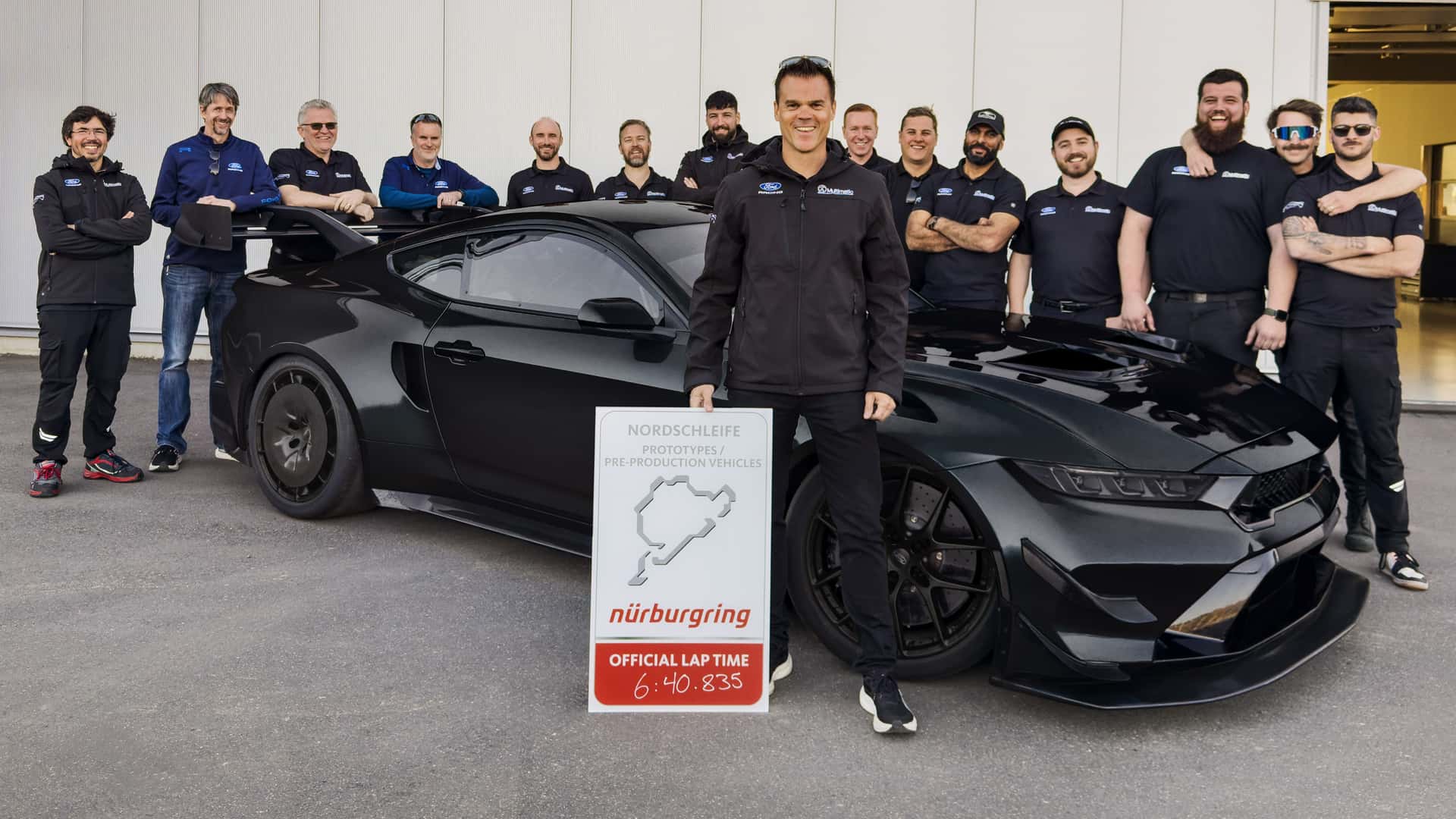
Ford's new Mustang GTD has reclaimed the title of the fastest American production car at Germany's Nürburgring Nordschleife, setting a blistering official lap time of 6 minutes and 40 seconds. This victory over the Chevrolet Corvette ZR1X by over eight seconds marks a pivotal moment in the escalating performance war between Detroit's historic rivals and signals a new era of track-focused, road-legal hypercars emerging from the United States.
What Happened
The Ford Mustang GTD has shattered the Nürburgring lap record for American production cars, completing the 12.9-mile Nordschleife circuit in a staggering 6 minutes and 40 seconds. This achievement dethrones the Chevrolet Corvette ZR1X, which held the record with a 6:48.2 lap set in late 2025, and reasserts Ford's performance engineering prowess on the world's most demanding proving ground.
Key Facts
- The official lap time recorded on Friday, April 17, 2026, was 6:40.0, verified by an independent timing specialist.
- The margin of victory over the previous record-holder, the Chevrolet Corvette ZR1X, was a substantial 8.2 seconds.
- The driver for the record attempt was Ford Performance's lead development driver, though the company has not yet released the specific name.
- The Mustang GTD is a $325,000, limited-production, road-legal car developed jointly by Ford Performance and Multimatic, the engineering firm behind the championship-winning Ford GT race program.
- Key technical features that enabled the record include a rear-mounted transaxle for perfect 50/50 weight distribution, an active aerodynamic system with a deployable rear wing, and a suspension derived from the GT3 race car.
- Power output comes from a supercharged 5.2-liter V8 engine, producing an estimated 800 horsepower, sent to the rear wheels through an 8-speed dual-clutch transmission.
Breaking It Down
Ford's decisive victory at the Nürburgring is more than a simple bragging rights exercise; it is a meticulously executed statement of technological intent. The 8.2-second gap is a massive margin on a circuit where rivals often trade blows by tenths of a second. This demonstrates that the Mustang GTD is not just incrementally better but represents a fundamentally different approach to the American performance car. By leveraging the race-bred architecture and carbon fiber construction expertise of Multimatic, Ford has effectively built a street-legal GT3 car, bypassing traditional road car compromises that its competitors must still navigate.
The 6:40 lap time not only crushes the American record but also places the Mustang GTD firmly within the realm of European hypercar exotica, beating the lap times of legendary machines like the Porsche 918 Spyder (6:57) and the Lamborghini Aventador SVJ (6:44.97).
This is the single most significant implication of the record. Ford has vaulted its iconic pony car badge into a performance stratosphere previously occupied solely by multi-million-dollar limited-run hypercars from Europe. The lap time suggests that Detroit's engineering, when unshackled from cost constraints for a halo model, can now go toe-to-toe with the best from Stuttgart, Sant'Agata, and Woking. It redefines the ceiling for American automotive performance and resets customer expectations for what a Ford badge can represent.
The strategic timing of this announcement is also critical. By reclaiming the "fastest American car" crown just months after the Corvette ZR1X took it, Ford has successfully disrupted Chevrolet's marketing narrative and seized momentum. This record serves as the ultimate validation for the GTD's extreme price tag and limited availability, proving its capabilities on the global stage. It transforms the car from a curious, expensive experiment into a certified performance legend on its first official outing, a masterstroke in performance marketing that will resonate for years.
What Comes Next
The fallout from this record lap will trigger immediate and calculated responses across the automotive industry, particularly within Detroit.
- An official response from Chevrolet Performance is imminent. The engineering team behind the Corvette ZR1X will be under intense pressure to analyze the GTD's data and publicly address the record. Speculation will immediately turn to whether a revised "ZR1X Track Package" or a new variant is already in development to reclaim the title, potentially before the end of 2026.
- Independent verification and media test drives will be the next major milestone. While Ford has presented an official time, the automotive press and rival manufacturers will scrutinize the details. The first independent reviews and behind-the-wheel experiences by top automotive journalists, likely scheduled for late Q2 or Q3 2026, will be crucial for confirming the GTD's real-world performance and drivability.
- Customer deliveries and real-world ownership begin. The first of the approximately 1,000 planned Mustang GTD units are scheduled to reach customers in the second half of 2026. How this radical, track-focused machine handles daily use, its reliability, and its performance at customer track days will be the final test of its execution.
- The impact on Ford's broader performance lineup will become clear. Technology and design language from the GTD program are expected to trickle down to future Mustang variants, including the next-generation GT3 and GT4 race cars, and potentially even higher-performance versions of the standard Dark Horse model.
The Bigger Picture
The Mustang GTD's achievement is a flagship example of the Track-to-Street Technology Transfer trend, where motorsport-derived engineering—once reserved for pure race cars—is being directly implemented in road-legal vehicles. Features like the GTD's pushrod-activated inboard suspension, derived from its GT3 sibling, represent a level of integration previously unseen in factory-produced American cars. This blurs the line between race shop and production line, offering consumers unprecedented performance.
Furthermore, this record accelerates the American Hypercar Democratization movement. For decades, ultimate performance was synonymous with seven-figure European brands. The Corvette ZR1X began challenging that notion, and the Mustang GTD has now forcefully advanced it. These cars offer hypercar-level track capability at a fraction of the cost (though still extremely expensive), forcing the established elite to justify their massive price premiums. This competition is expanding the apex of the performance car pyramid and inviting new players into the most exclusive club in the automotive world.
Key Takeaways
- Record Reclaimed: Ford Mustang GTD's 6:40.0 Nürburgring lap decisively retakes the American production car record from the Chevrolet Corvette ZR1X by a dominant 8.2-second margin.
- Technical Benchmark: The car's success is rooted in an unprecedented race-to-road engineering approach, utilizing a GT3-derived chassis and active aero to compete with European hypercars.
- Marketing Coup: The timing of the record immediately counters Chevrolet's narrative and validates the GTD's $325,000 price point, serving as a powerful halo for the entire Ford Performance brand.
- Industry Escalation: This result guarantees a renewed performance war, pressuring Chevrolet to respond and signaling that Detroit is now a permanent player in the ultimate track-performance arena.