TL;DR
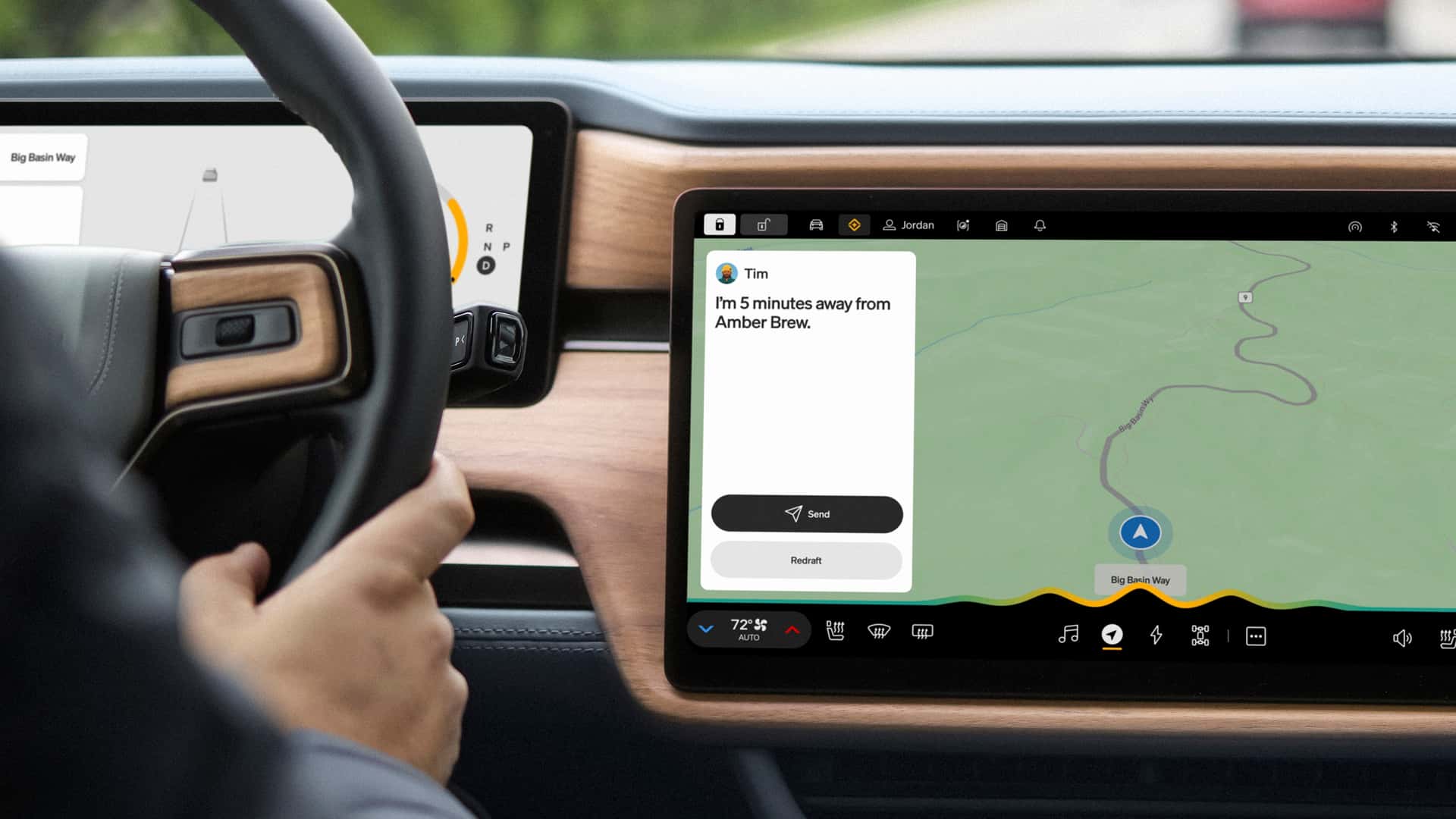
Rivian has begun rolling out its own proprietary AI voice assistant, the Rivian Assistant, to R1S and R1T owners via a new over-the-air software update. This move marks Rivian's direct entry into the in-car AI assistant space, positioning it against Tesla, Google, and Apple, and the R2 is confirmed as the next vehicle to receive the feature.
What Happened
On Wednesday, May 13, 2026, Rivian began pushing a major over-the-air software update to its R1S and R1T electric vehicles, introducing the Rivian Assistant — a proprietary AI-powered voice assistant built entirely in-house. The update, which started rolling out to customers immediately, equips the startup's flagship models with natural language processing, vehicle control commands, and contextual awareness, with the upcoming R2 crossover confirmed as the next platform to receive the feature.
Key Facts
- The Rivian Assistant is rolling out via an over-the-air (OTA) software update to the R1S and R1T, Rivian's current production models.
- The assistant uses natural language processing to understand conversational commands, not just rigid keyword phrases.
- Key capabilities include controlling climate, navigation, media, and vehicle settings like drive modes and suspension height.
- The assistant can answer vehicle-specific questions, such as range estimates, tire pressure, and charging status.
- Rivian built the assistant in-house, meaning it is not a rebranded version of Amazon Alexa, Google Assistant, or any third-party platform.
- The R2, Rivian's smaller and more affordable crossover slated for production in early 2027, is confirmed as the next vehicle to get the assistant.
- The rollout began on May 13, 2026, with no staggered regional delays reported for the initial wave.
Breaking It Down
The Rivian Assistant represents a strategic pivot for the company, which had previously relied on Amazon Alexa integration for voice commands in its vehicles. By developing its own AI assistant, Rivian gains full control over the user experience, data collection, and feature development timeline — a move that mirrors Tesla's approach with its own voice command system and Apple's philosophy of vertical integration.
Rivian is now the third automaker — after Tesla and Mercedes-Benz — to ship a fully proprietary, AI-native voice assistant in a production electric vehicle, bypassing Google and Amazon's automotive platforms entirely.
This decision carries significant implications for Rivian's software revenue strategy. Unlike Tesla, which bundles its voice assistant with the base vehicle, Rivian could eventually offer premium tiers of its assistant as a subscription add-on, similar to how Mercedes-Benz charges for its MBUX Voice Assistant enhancements. The in-house build also means Rivian can iterate faster, pushing updates without waiting for a third-party partner like Amazon to approve changes.
The assistant's ability to handle contextual commands — such as "navigate to the nearest DC fast charger and pre-condition the battery" — represents a meaningful step beyond the scripted, single-action commands that defined earlier automotive voice systems. Rivian's engineering team has likely trained the model on thousands of hours of real-world driving data and owner queries, giving it a specificity that generic assistants lack. For example, the assistant can answer "How much range do I have left if I drive to the trailhead?" by factoring in elevation gain and current battery temperature — a scenario specific to Rivian's outdoor-focused customer base.
What Comes Next
The immediate priority is a full rollout to all existing R1S and R1T owners, which Rivian expects to complete within two weeks. After that, attention shifts to the R2 and future software capabilities.
- R2 integration confirmed: The Rivian Assistant will be a standard feature on the R2, which enters production in early 2027. Rivian has not said whether it will offer the assistant on the R3 or R3X, but the platform architecture suggests it will be shared across the lineup.
- Third-party app integration: Rivian has hinted at future support for controlling smart home devices (e.g., "pre-heat my house when I'm 30 minutes away") and integrating with calendars for route planning. No timeline has been given.
- Multilingual support: The initial rollout is English-only for North American markets. European and international expansion will require localization, likely in late 2026 or early 2027.
- Potential subscription tier: Rivian could introduce a premium assistant with advanced features like natural language trip planning, real-time traffic rerouting with AI suggestions, or integration with third-party services like Spotify and YouTube Music. No pricing has been announced.
The Bigger Picture
This launch sits at the intersection of two major trends: automaker vertical integration and AI commoditization in the cockpit. Rivian is following Tesla and Mercedes in concluding that third-party voice assistants (Amazon Alexa, Google Assistant) are too generic for the automotive use case. By building its own, Rivian can optimize for EV-specific commands (charging, range, battery health) and off-road scenarios (suspension settings, trail navigation) that general assistants handle poorly.
The broader trend is the death of the generic car voice assistant. As automakers realize that voice is the primary interface for the software-defined vehicle, they are pulling development in-house. General Motors, for example, has its own "Intelligent Assistant" powered by Google's Automotive Services, but it still relies on Google's cloud. Rivian's fully proprietary approach is rarer, and it signals that the company views the assistant as a core differentiator — not just a feature — for its brand identity as a tech-forward, adventure-oriented automaker.
Key Takeaways
- [In-House Build]: Rivian developed the assistant from scratch, rejecting Amazon Alexa and Google Assistant, giving it full control over data, features, and monetization.
- [R1 Platform First]: The R1S and R1T received the update on May 13, 2026; the R2 is confirmed as the next vehicle to get the assistant.
- [Contextual Commands]: The assistant can handle multi-step, conversational requests like battery pre-conditioning and route planning in a single command.
- [Subscription Potential]: Rivian has not announced pricing, but the in-house architecture leaves the door open for a premium tier or subscription model for advanced features.